What identity verification requires in Argentina
The obligation does not come from a rule about documents: it comes from the UIF requiring that the customer be known before they are allowed to transact, and from the BCRA when it is also a financial institution. Verifying identity is the first link in that duty, and the one that produces the evidence on which all the others rest.
In Argentina the document is the DNI and the body that issues it is RENAPER, the Registro Nacional de las Personas (national registry of persons). That distinction sets the quality ceiling of any verification: the document is a printed claim, and the RENAPER record is what that claim is checked against.
Translated into what a process has to settle, these are four distinct checks, and all four have to leave a record.
- That the document is authentic — full reading of the document presented and validation of its security features, not just the number.
- That the person on the document is the one on the other side — biometric matching between the captured face and the one on the document.
- That this person is present and alive — liveness detection, which is what separates a real face from a photo, a recorded video or a synthetic face.
- That the declared data is consistent — cross-checking against the available sources and against the applicable restricted lists.
All four produce evidence. That evidence is the customer file, and the customer file is what the supervisor looks at.
The Argentine documents that are read
Argentina has five documents covered, and all of them coexist in circulation at the same time. A sign-up flow can receive a blue booklet and an electronic DNI on the same day, and what is read from each one is not the same.
First card DNI (2009–2012)
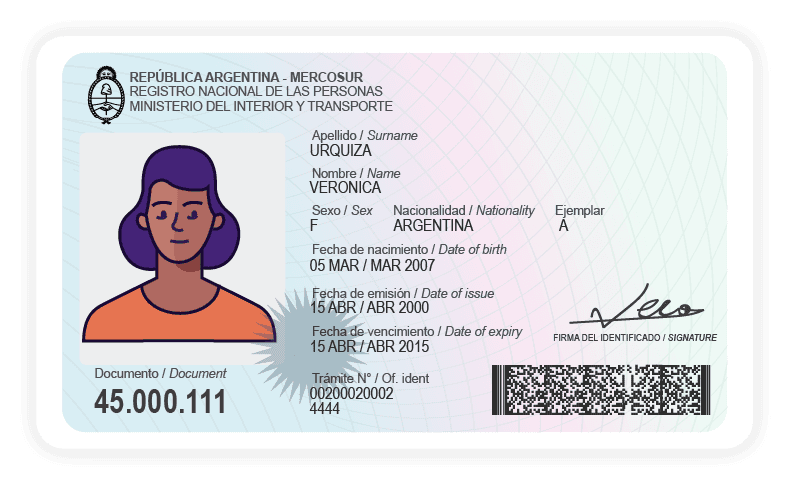
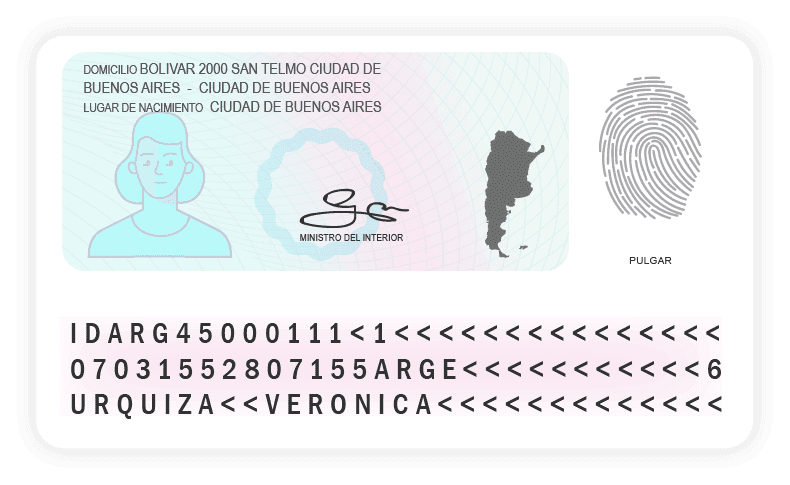
The printed text, the barcode and the machine-readable zone are read.
The match between the printed data, the barcode and the MRZ is validated, and the document is checked against RENAPER. It is one of the oldest versions in circulation and, for that reason, the one most often found expired.
First biometric DNI (2012–2020)
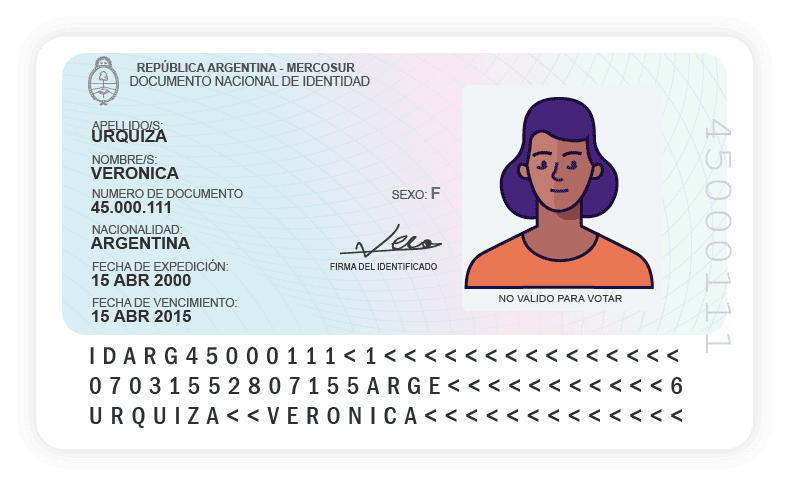
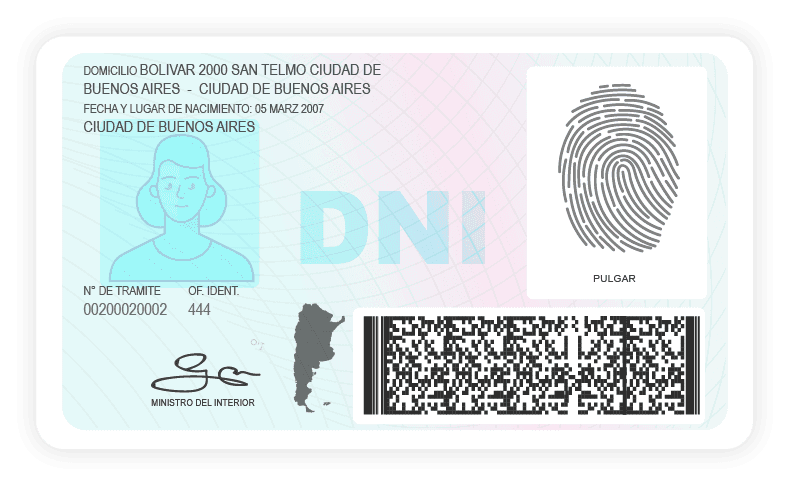
The same three readings: printed text, barcode and machine-readable zone.
The match between the printed data, the barcode and the MRZ is validated, and the document is checked against RENAPER. It is still valid and is one of the most frequently received at sign-up.
Blue booklet (2009–2012)
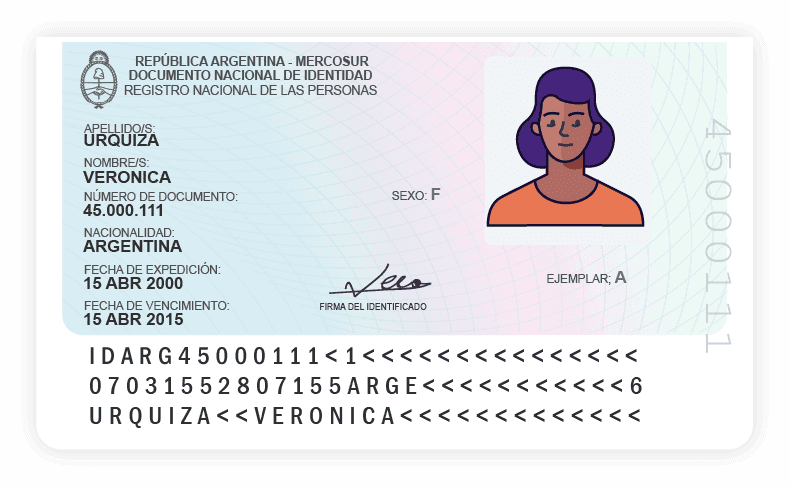
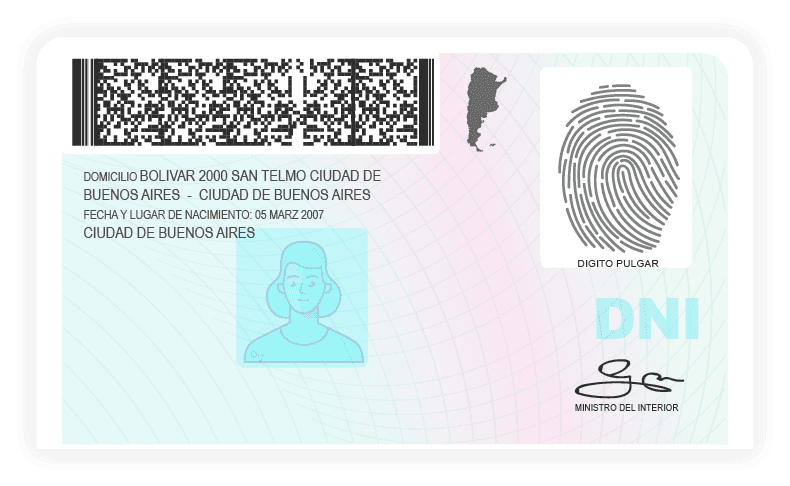
The same three readings.
The printed data, the barcode and the MRZ on the data page are validated, and the document is checked against RENAPER. Because it is a booklet and not a card, the capture takes both pages instead of front and back.
DNI with the bicontinental map (Since 2020)
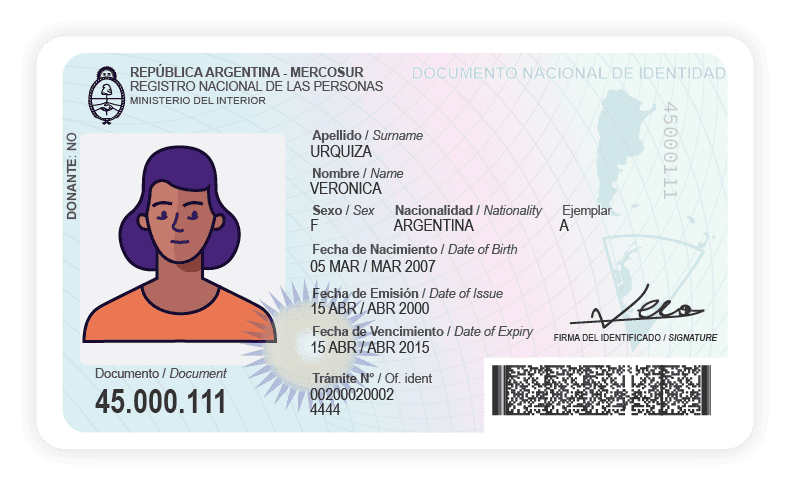
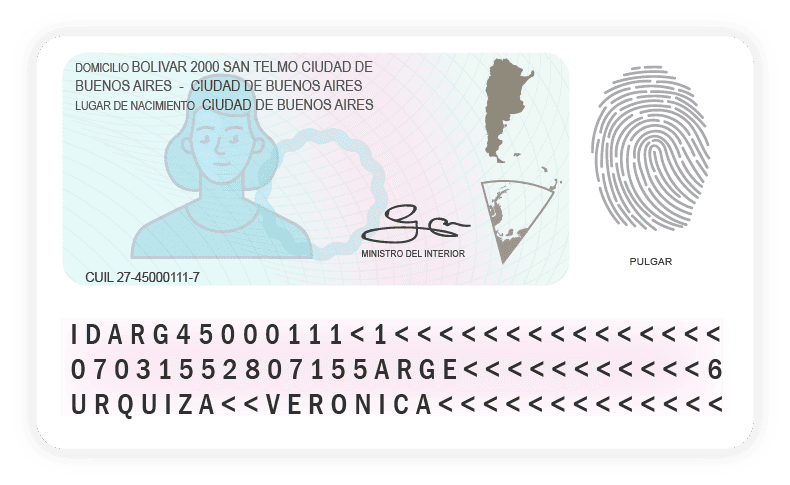
The same three readings: printed text, barcode and machine-readable zone.
The match between the printed data, the barcode and the MRZ is validated, and the document is checked against RENAPER. It is the version in regular issue until the arrival of the electronic DNI, so it is the most frequent in current flows.
Electronic DNI (Since 2026)
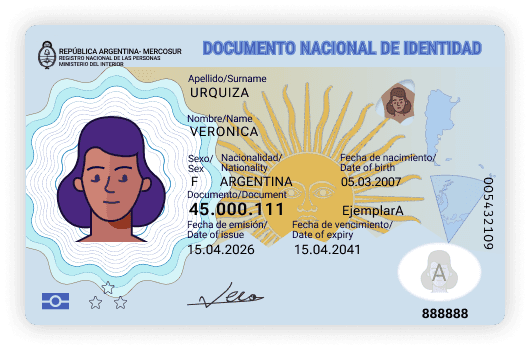
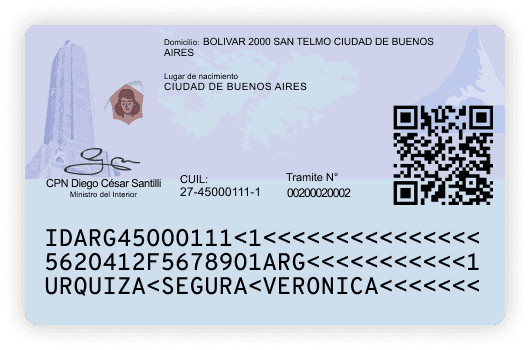
It is the only one of the five that is not read by barcode. The printed text, the machine-readable zone and a QR code are read. Reading the back changes mechanism, and a flow that assumes a barcode on every Argentine DNI fails precisely with the newest document.
The match between the printed data, the MRZ and the QR code on the back is validated, and the document is checked against RENAPER. A flow that assumes a barcode on every Argentine DNI rejects precisely this version, the newest one.
Images are reference templates with fictitious data.
The three mechanisms each have their own glossary entry: OCR for printed text, PDF417 for the barcode and MRZ for the machine-readable zone.
What it is checked against
Argentina is one of the eight countries where verification queries a government source, along with Bolivia, Colombia, Ecuador, Honduras, Paraguay, Peru and the Dominican Republic. In practice that changes the nature of the check: it stops merely validating what the document shows and moves on to checking against the record of the body that issued it.
The difference matters when operating in several countries. In Chile that query does not exist and verification relies only on the document presented and on biometrics. A team running the same flow in both markets is not buying the same control in each, and it is worth knowing that before designing the exception process.
What is not read, and why
Two clarifications that prevent a mistaken expectation.
- No element of the DNI is left unread. Argentine coverage does not document any field that exists on the document and cannot be read. The only change of mechanism between generations is the electronic DNI's QR code instead of the barcode.
- Argentine coverage is DNI, and DNI only. It does not include the Argentine passport or documents of foreign nationals. A flow that receives a passport or another country's identity card falls outside this coverage and needs an exception route defined in advance.
What VU automates in identity verification
VU handles the mechanical, repeatable part of the four checks, within a single flow.
- Document reading — capture and extraction of the fields according to what each DNI generation supports: printed text, barcode, machine-readable zone or QR code.
- Biometric matching — the captured face against the one on the document, with the front and back of the document itself cross-checked.
- Liveness detection — to establish that there is a real, present person at the moment of capture.
- Orchestration of the steps — the order, retries, timeouts and what to do when a step does not complete, which is where a digital sign-up breaks down in practice.
- Trail of each step — the record of what ran, with what result and when, which is what gets shown later.
And what VU does not do, which matters just as much:
- It does not decide whether a person is acceptable. That is the obligated party's risk policy, and the law requires it of them, not of their provider.
- It does not issue or correct documents. That belongs to RENAPER. If a piece of data in the registry is wrong, the verification will reflect that error, not fix it.
- It does not interpret the law or assemble the regulatory customer file. VU produces evidence; what is retained, for how long and in what format is defined by the regime and decided by the compliance team.
- It does not verify documents outside the country's coverage. A foreign passport in an Argentine flow needs another route.
- It does not do transaction monitoring. Verification establishes who someone is at sign-up. What that person does afterwards is another control and another page.
Use cases in Argentina
Where this problem shows up in the real operation of the Argentine market.
Account and wallet opening through digital channels. Remote sign-up is today the default channel for much of the system, and with it identification went from an employee looking at a document to a process that has to prove itself.
Sign-up at virtual asset service providers. It is the newest category of obligated party and the one that arrives with the least process legacy, so verification is designed from scratch and without an inherited manual.
Five generations of DNI coexisting. A flow that only accounts for the most common document starts piling up manual exceptions, and the cost shows up in the support team before it does in compliance.
Updating the files of customers onboarded in person. People signed up years ago, with paper evidence or no useful evidence, who have to be verified again without forcing them to go to a branch.
Transactions with a document outside coverage. Foreign nationals, resident or in transit, who present a document the automatic flow does not read, and who need an exception route that is not improvised on the spot.
Frequently asked questions
The DNI, in the generations that are valid at the time of verification. Several coexist in Argentina at the same time, from the first card-format versions to the most recent electronic DNI, and a serious process has to account for all the ones it can receive in practice, not just the newest. What changes between generations is not the legal value of the document but which elements it carries for automatic reading, which is why the flow is designed around the real document base and not the ideal one.
No. Identity verification establishes that a person is who they claim to be and produces the evidence of that check. KYC is the broader duty the UIF requires: besides identifying, it includes understanding the customer's profile, scaling diligence by their risk, keeping the information up to date throughout the relationship and retaining the customer file. Identity verification is the first link in that duty and the one that produces the proof, but a process can verify flawlessly and still fail to comply with KYC.
RENAPER is the body that records the identity of people in Argentina and issues the DNI, so it is the reference against which an identity is attested in the country. Checking against the issuer's registry is different from validating what the document shows: the first asks whether that person exists as declared, the second only checks that the card is consistent with itself.
It depends on the generation. The versions prior to the electronic DNI carry printed text, a barcode and a machine-readable zone, and all three are read. The electronic DNI replaces the barcode with a QR code, so reading the back works with a different mechanism. The practical consequence is that a flow that assumes a single reading mechanism for every Argentine DNI starts failing precisely with the newest document, which is the one that will grow most in volume.
An image of the document settles only one of the four checks, and only partly. It makes it possible to read the data, but it says nothing about whether the sender is the holder, whether there is a real person on the other side at that moment, or whether the data is consistent with any source. A process built on a photo sent over a messaging app is the easiest scenario to attack there is: the image can be of a stolen document, a screenshot or a purchased file.