Model any data, no parallel databases
An Attribute Set groups everything an identity type needs, without designing a separate database to store it.
An Attribute Set groups the full data kit that an identity type needs, from a simple field to a full address or a list, and is configured from the backoffice, without development. Configurable by business unit and account type.
An Attribute Set is the VU ONE unit that groups the data schemas an identity type needs: the complete information kit, defined once and reused without parallel databases.
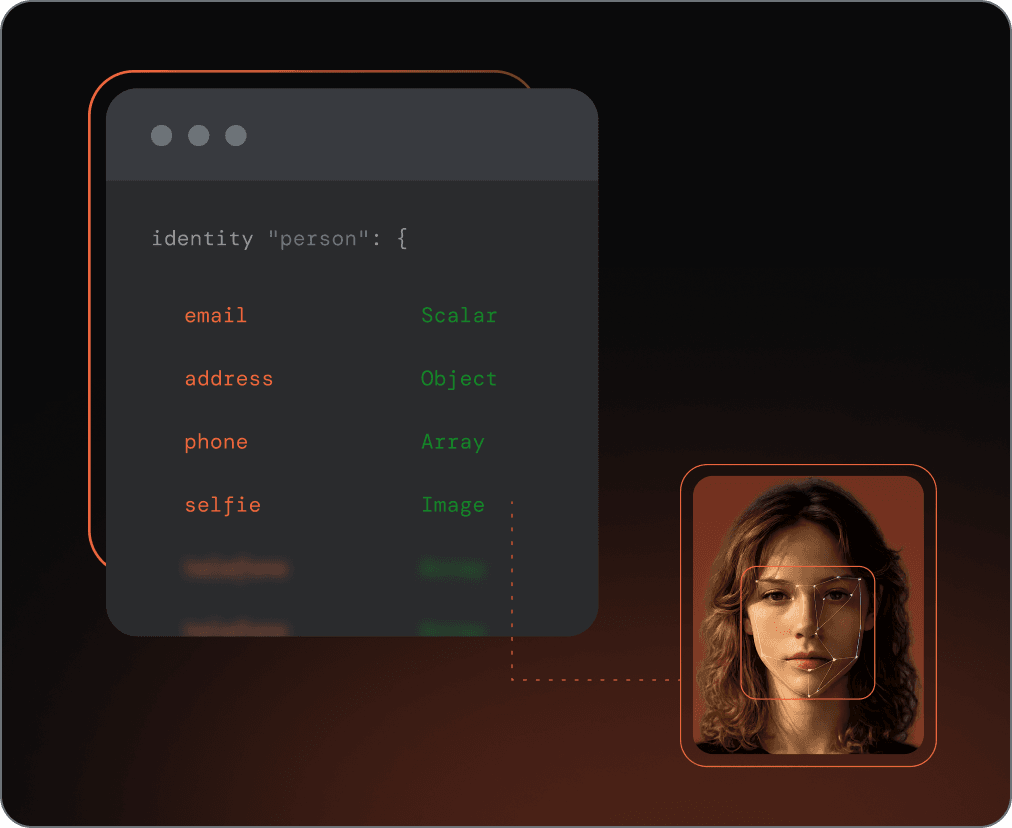
Scalar, Object and Array.
Each set is associated with a business unit and an account type.
Create, filter, edit, query and delete, without development.
Any set can be marked as an identifier, with its own matching strategy.
Organizations that trust us to model the data of each identity



















An Attribute Set groups everything an identity type needs, without designing a separate database to store it.
Create, filter, edit, query, and delete: the full lifecycle of an attribute is managed from screens, not from a development project.
From a single field to a complete address — street, city, postal code — or a list, with the exact schema for each case.
Each business unit configures its own attribute sets, depending on whether the account belongs to a customer, a service, or the workforce.
An Attribute Set groups everything an identity type needs, without designing a separate database to store it.
Create, filter, edit, query, and delete: the full lifecycle of an attribute is managed from screens, not from a development project.
From a single field to a complete address — street, city, postal code — or a list, with the exact schema for each case.
Each business unit configures its own attribute sets, depending on whether the account belongs to a customer, a service, or the workforce.
groups the schemas that represent a characteristic, condition, or business policy: the information kit an identity type needs to operate.
from an atomic field — text, number, boolean — to grouped data such as an address or lists with their own quantity and uniqueness rules.
any set can be marked as an identifier for verification or authentication, defining whether all attributes must match or one is enough.
each set applies according to the account type — customer, service, or workforce — and its subtype: local, social, or federated.
define whether the data lives at the identity level or at the account level, according to who actually owns it.
schemas automatically generate forms and are compatible with CRMs and the SCIM protocol.
Choose whether it is a simple field (Scalar), grouped data such as an address (Object), or a list (Array), with its validation rules.
Model regulatory attributes for each customer type without duplicating the data model by product.
Define the exact attribute set each procedure needs, from citizen to public official.
One attribute set per account type — player, buyer, affiliate — without parallel databases.
Model the attributes of each type of check —employment, credit, criminal— without duplicating the data model per product.
Configurable claims and attributes is part of VU ONE, the platform that unifies identity verification, authentication and fraud prevention in a single SDK.
Learn about VU ONEConfigure attributes and identifiers without touching a database or opening a development project.