What identity verification requires in Bolivia
The obligation does not come from a rule about documents: it comes from the fact that the regime for preventing money laundering and terrorist financing enforced by the UIF requires knowing the customer before letting them transact, and that the ASFI supervises how the institutions in the financial system meet that duty. Verifying identity is the first link, and the one that produces the evidence on which all the others rest.
In Bolivia the document for nationals is the cédula de identidad (national ID card), issued by SEGIP, the Servicio General de Identificación Personal, which records the identity of people. That distinction sets the quality ceiling of any verification: the document is a printed claim, and the issuer's registry is what that claim is checked against.
Translated into what a process has to settle, these are four distinct checks, and all four have to leave a record.
- That the document is authentic — full reading of the document presented and validation of its security features, not just the number.
- That the person on the document is the one on the other side — biometric matching between the captured face and the one on the document.
- That this person is present and alive — liveness detection, which is what separates a real face from a photo, a recorded video or a synthetic face.
- That the declared data is consistent — cross-checking against the available sources and against the applicable restricted lists.
All four produce evidence. That evidence is the customer file, and the customer file is what the supervisor looks at.
The Bolivian documents that are read
Bolivia has five documents covered: four cédulas de identidad and the passport. The four cédulas coexist on the street at the same time, and what is read from each one is different. This is the biggest difference from other countries in the region, where successive generations read almost the same.
A note on dates. The cédula with QR code has been in force since 2020 and the Bicentennial cédula since 2026. No period is given for the other three documents.
Electronic cédula
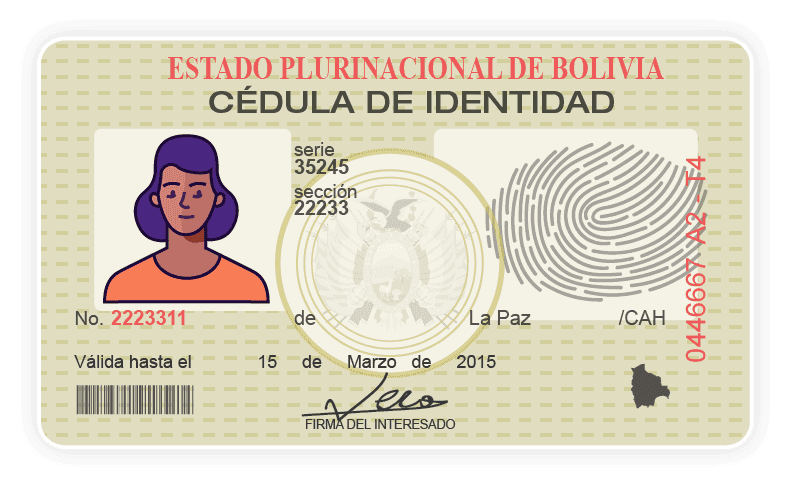
Only the printed text is read.
The document's printed text is validated and checked against the issuing body's registry. There is no barcode or MRZ to cross-check, so the reading depends on image quality. Bolivian coverage does not include chip reading.
Cédula with biometrics
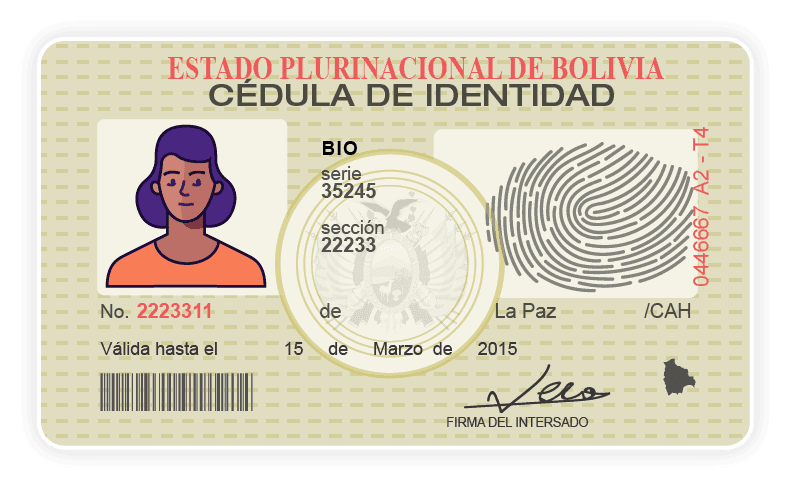
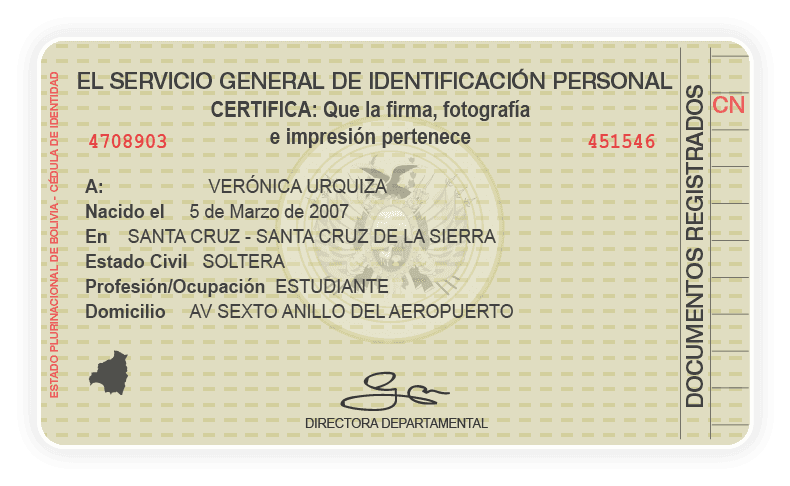
The printed text and the barcode are read. It is the only one of the five Bolivian templates read by barcode.
The match between the printed data and the barcode is validated, and the document is checked against the issuing body's registry. It is the only one of the Bolivian templates read by barcode.
Cédula with QR code (In force since 2020.)
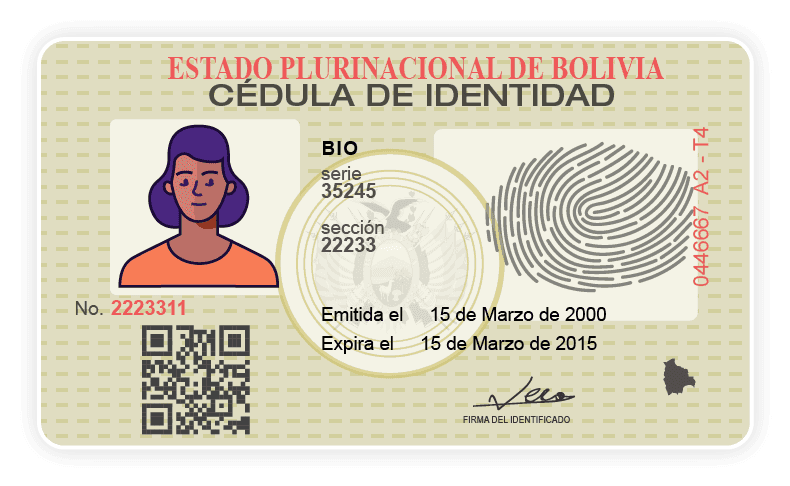
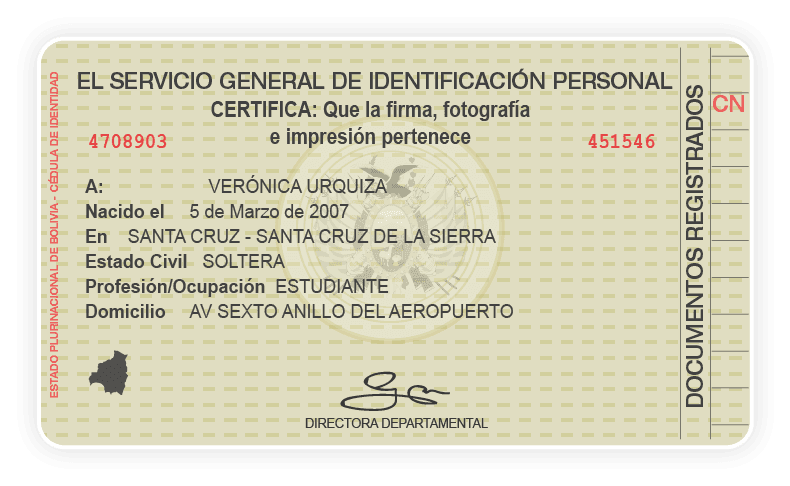
Only the printed text is read. The document's name comes from a QR code that current coverage does not read, and saying so matters: it is exactly the point where a team assumes structured data is available and designs the flow on a reading that does not happen.
The printed text is validated and the document is checked against the issuing body's registry. The QR code is on the document but current coverage does not read it, so there is no structured data to cross-check.
Bicentennial cédula (In force since 2026.)
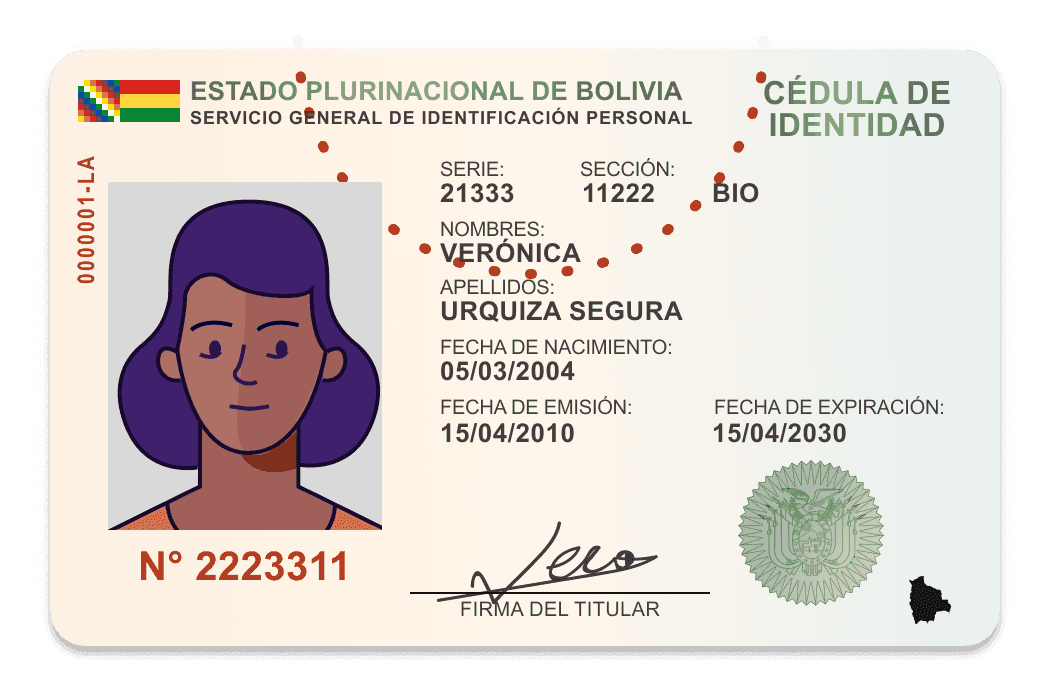
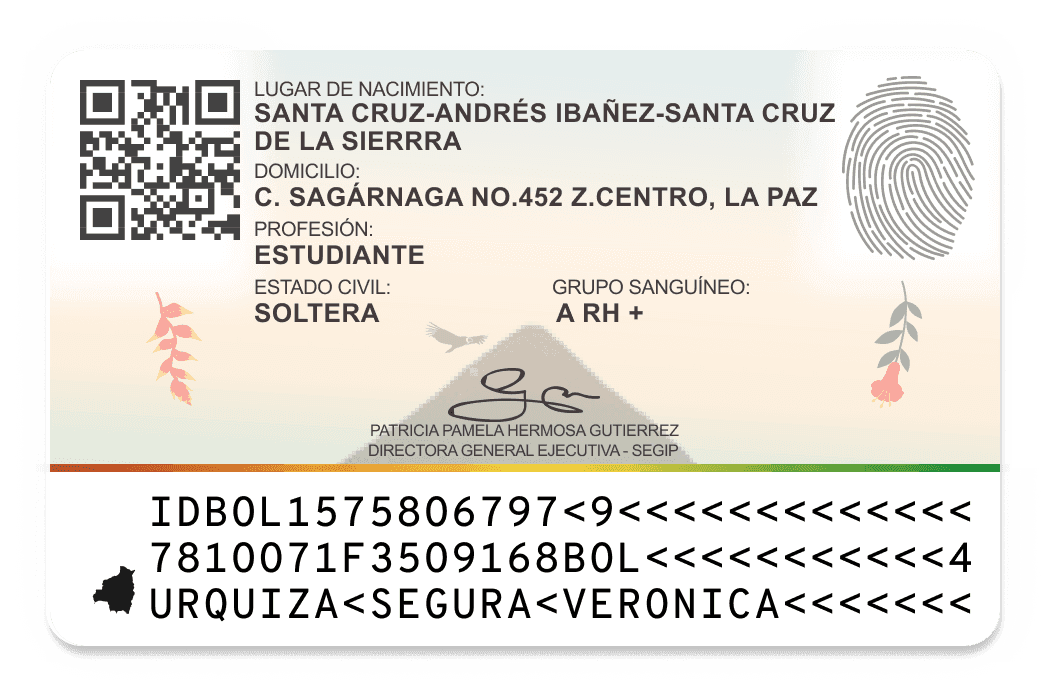
The printed text and the machine-readable zone are read.
The match between the printed data and the MRZ is validated, and the document is checked against the issuing body's registry.
Bolivian passport
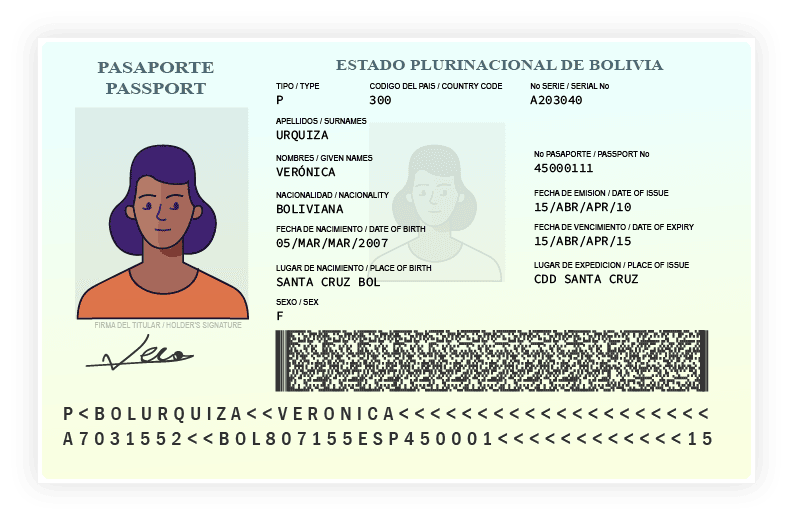
The printed text and the machine-readable zone are read.
The match between the printed data and the MRZ is validated. It has no check against the registry, so verification relies on the document, biometric matching and liveness detection.
Images are reference templates with fictitious data.
- Electronic cédula: Printed text
- Cédula with biometrics: Printed text · barcode
- Cédula with QR code: Since 2020 · Printed text
- Bicentennial cédula: Since 2026 · Printed text · machine-readable zone
- Bolivian passport: Printed text · machine-readable zone
Two of the four cédulas rely only on the printed text, and that is a real limitation. When a document carries a barcode or a machine-readable zone, the process obtains the data already structured and with its own integrity check, and can cross-check it against what it read from the image. When there is only printed text, that second reading does not exist: everything depends on the quality of the photo, the lighting and the condition of the card. It does not mean the document cannot be verified, it means that the rate of retries and of routing to manual review will be higher with the electronic cédula and the cédula with QR code than with the other two, and that it is best to account for it in the design of the flow and in the capacity of the team that handles exceptions.
What it is checked against
In Bolivia, verification queries a government source. In practice that changes the nature of the check: it stops validating only what the document shows and moves on to checking against the registry of the body that issued it.
And in Bolivia that query makes up for part of what the document does not give. It reaches the four cédulas and not the passport.
- Electronic cédula: Yes
- Cédula with biometrics: Yes
- Cédula with QR code: Yes
- Bicentennial cédula: Yes
- Bolivian passport: No
The two asymmetries intersect and are best read together. The electronic cédula and the cédula with QR code are the ones from which the least is read off the document itself, and they are also the ones that do have a check against the registry: what the card does not deliver in structured form, the registry confirms. The passport is the reverse case: it reads well, machine-readable zone included, and does not have that second layer. A Bolivian flow that treats the five documents the same is applying the same threshold to checks that do not have the same strength.
That query does not exist in every market, and where it does not exist verification relies only on what is presented and on biometrics. A team running the same flow in several markets is not buying the same control in all of them.
What is not read, and why
Three clarifications that prevent a mistaken expectation.
- The QR code on the cédula named after it is not read. The element is on the document and current coverage does not make use of it. It is the Bolivian equivalent of the encrypted barcode in other countries: an element that is present and delivers no data.
- Bolivian coverage is cédulas and the passport, and nothing else. It does not include documents of foreign nationals issued in Bolivia or documents from other countries. A flow that receives them needs an exception route defined in advance.
- Bolivian coverage does not include chip reading. The name "electronic cédula" invites the assumption that there is a chip that is read, and that is not the case: no chip is read on any of the five documents.
What VU automates in identity verification
VU handles the mechanical, repeatable part of the four checks, within a single flow.
- Document reading — capture and extraction of the fields according to what each template supports: printed text, barcode or machine-readable zone, without asking the user to know which one they have.
- Biometric matching — the captured face against the one on the document, with the front and back cross-checked when the document has two covered sides.
- Liveness detection — to establish that there is a real, present person at the moment of capture.
- Orchestration of the steps — the order, retries, timeouts and what to do when a step does not complete. In Bolivia this weighs more than in other countries, because two of the four cédulas depend entirely on image quality.
- Trail of each step — the record of what ran, with what result and when, which is what gets shown later.
And what VU does not do, which matters just as much:
- It does not decide whether a person is acceptable. That is the obligated party's risk policy, and the rules require it of them, not of their provider. The decision on which threshold to apply to a passport, which has no check against the registry, is exactly of this kind.
- It does not issue or correct documents. That belongs to the issuing body. If a piece of data in the registry is wrong, the verification will reflect that error, not fix it.
- It does not interpret the law or assemble the regulatory customer file. VU produces evidence; what is retained, for how long and in what format is defined by the regime and decided by the compliance team.
- It does not verify documents outside the country's coverage.
- It does not do transaction monitoring. Verification establishes who someone is at sign-up. What that person does afterwards is another control and another page.
Use cases in Bolivia
Where this problem shows up in the real operation of the Bolivian market.
Account and wallet opening through digital channels. Remote sign-up moves identification from an employee looking at a document to a process that has to prove itself, and in Bolivia it does so on a document base with uneven readings.
Four cédulas coexisting with different reading capabilities. It is not the usual case of generations that read the same: here each template delivers something different, so the same flow produces different experiences depending on which cédula the person has.
Cédulas that are read only by printed text. Photos with glare, a worn card or poor lighting turn into retries, and retries into abandonment. It is the point where capture quality stops being a technical detail.
Sign-ups with a passport. The document reads well and has no check against the registry, so it is the population where it is best to define soonest whether a different threshold or a review with human intervention applies.
Updating the files of long-standing customers. People signed up when the standard of evidence was different, who have to be verified again without forcing them to go to a branch, and who may present any of the four cédulas.
Frequently asked questions
The cédula de identidad (national ID card), in the versions in force at the time of verification, and the Bolivian passport. In Bolivia several cédulas coexist at the same time and not all of them deliver the same: some carry machine-reading elements, such as a barcode or a machine-readable zone, and others rely only on the printed text. A serious process accounts for all the ones it can receive in practice, and assumes that the experience of a person with one of the cédulas that are read only by text will include more retries than that of another.
No. Identity verification establishes that a person is who they claim to be and produces the evidence of that check. KYC is the broader duty the anti-money laundering regime requires: besides identifying, it includes understanding the customer's profile, scaling diligence by their risk, keeping the information up to date throughout the relationship and retaining the customer file. Identity verification is the first link in that duty and the one that produces the proof, but a process can verify flawlessly and still fail to comply with KYC.
In Bolivia that check exists, and it is a substantive difference from validating only what the document shows: asking the registry whether that person exists as declared is a different check from checking that the card is consistent with itself. In Bolivia that layer accompanies the cédulas and not the passport.
Because not all of them carry the same elements designed for machine reading. A barcode or a machine-readable zone delivers the data already structured, with its own integrity check, and makes it possible to cross-check it against what was read from the image. When the document only has printed text, that second reading does not exist and everything depends on the quality of the photo. The practical consequence is not that the document is of no use, but that the flow will produce more retries and more routing to manual review with those templates, and it is best to size the exceptions team knowing that.
It is verified all the same, with different backing. The Bolivian passport reads well, including its machine-readable zone, and goes through the same checks: document reading, biometric matching and liveness detection. What it lacks is the check against the registry that does accompany the cédulas, so the verification is left with one layer fewer. That asymmetry is resolved with a risk decision made in advance, not in the exception queue: whether that population goes through the same threshold, a more demanding one, or a review with human intervention.