What identity verification requires in Brazil
The obligation does not stem from a rule about documents: it stems from AML/CFT (anti-money laundering and countering the financing of terrorism) rules, which require identifying and qualifying the customer before they transact, and from open finance, which requires authenticating that customer before granting any data-sharing consent. Verifying identity is the first link in those duties, and it is what produces the evidence on which all the others rest.
A second reader of the same evidence adds to this: the LGPD (Lei Geral de Proteção de Dados, Brazil's General Data Protection Law), which expressly names biometric data as sensitive personal data and asks on what legal basis it was processed.
Translated into what a process has to resolve, these are four distinct checks, and all four have to leave a record.
- That the document is authentic — full reading of the document presented and validation of its security features, not just the number.
- That the person on the document is the one on the other side — biometric matching between the captured face and the face on the document.
- That this person is present and alive — liveness detection, which is what separates a real face from a photo, a recorded video or a synthetic face.
- That the declared data are consistent — checks against available sources and applicable restrictive lists.
All four produce evidence. That evidence is the customer record, and the record is what the supervisor looks at.
The Brazilian documents that are read
Brazil has a heterogeneous document base, with six document types covered. An onboarding flow may receive an identity card issued two decades ago, a recent Carteira de Identidade Nacional and a driver's license on the same day, and what is read from each one is not the same.
Carteira de identidade (RG) (Issued before 2022.)
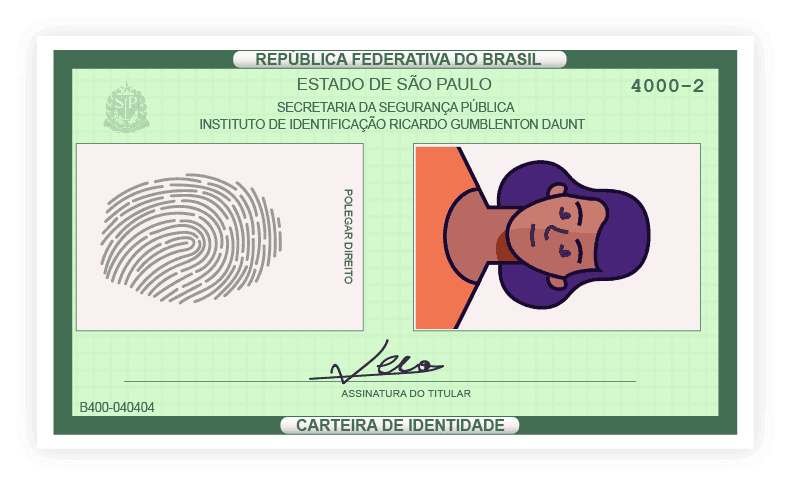
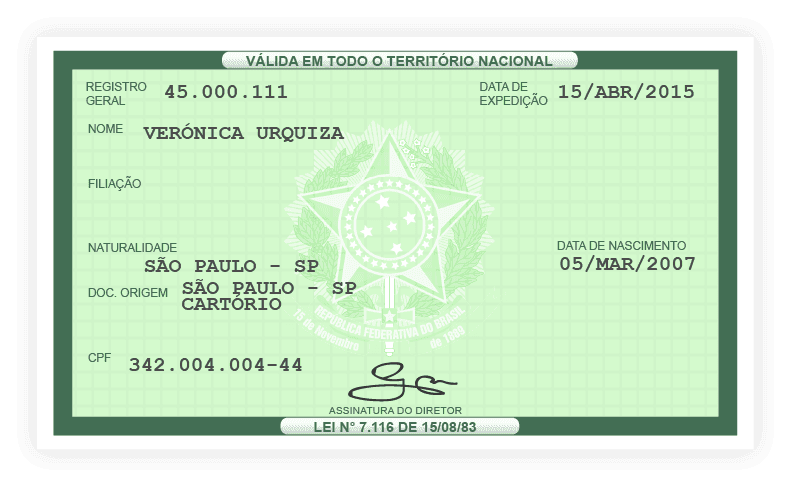
The printed text is read. There is no barcode or machine-readable zone.
The correspondence between the printed data on the front and back is validated. There is no barcode or machine-readable zone to check against, and the document is not checked online against an official Brazilian registry.
Carteira de Identidade Nacional (CIN) (Since 2022.)
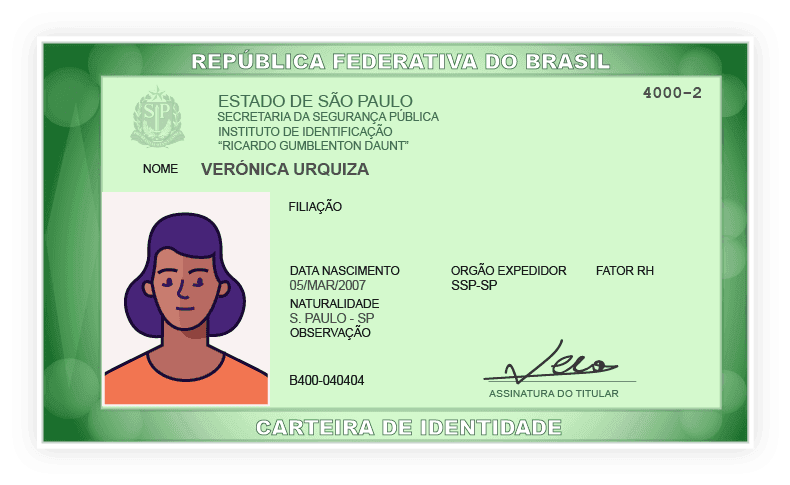
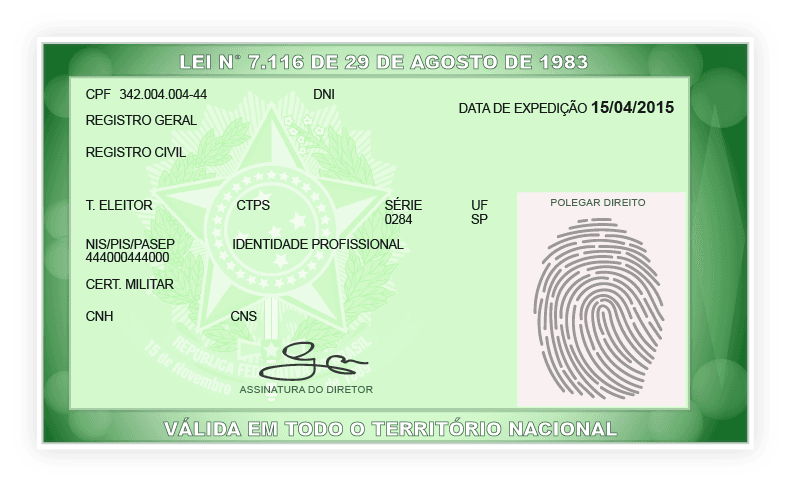
The printed text is read.
The correspondence between the printed data on the front and back is validated. Reading relies only on the printed text, and the document is not checked online against an official Brazilian registry.
Cédula de Identidade de Estrangeiro (CIE) (Until 2017.)
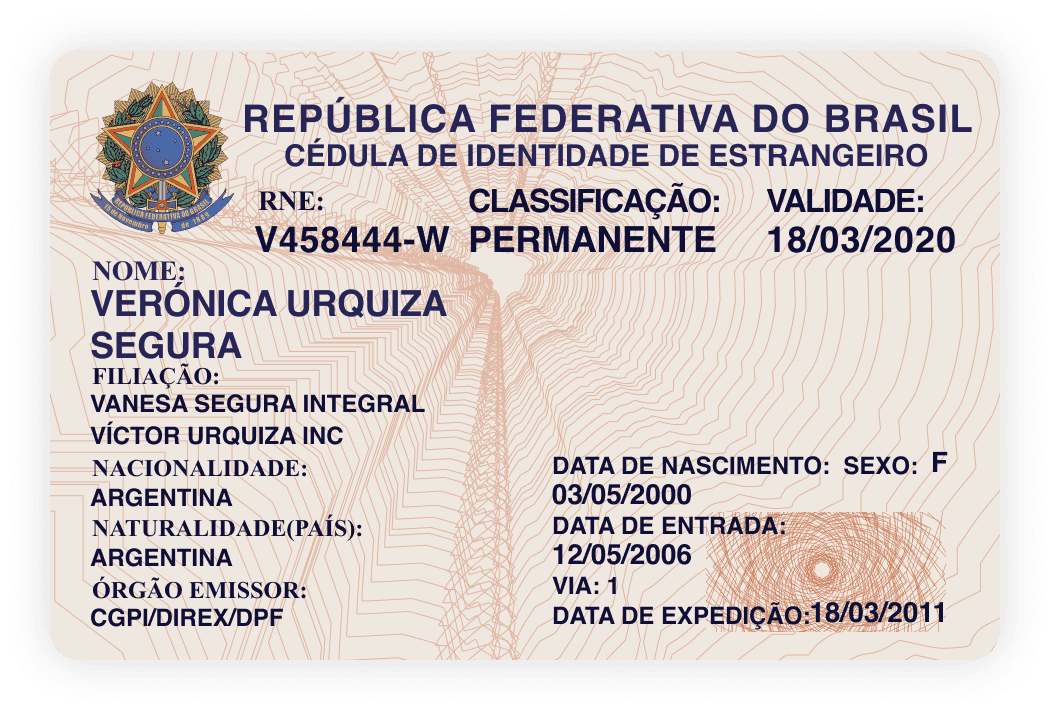
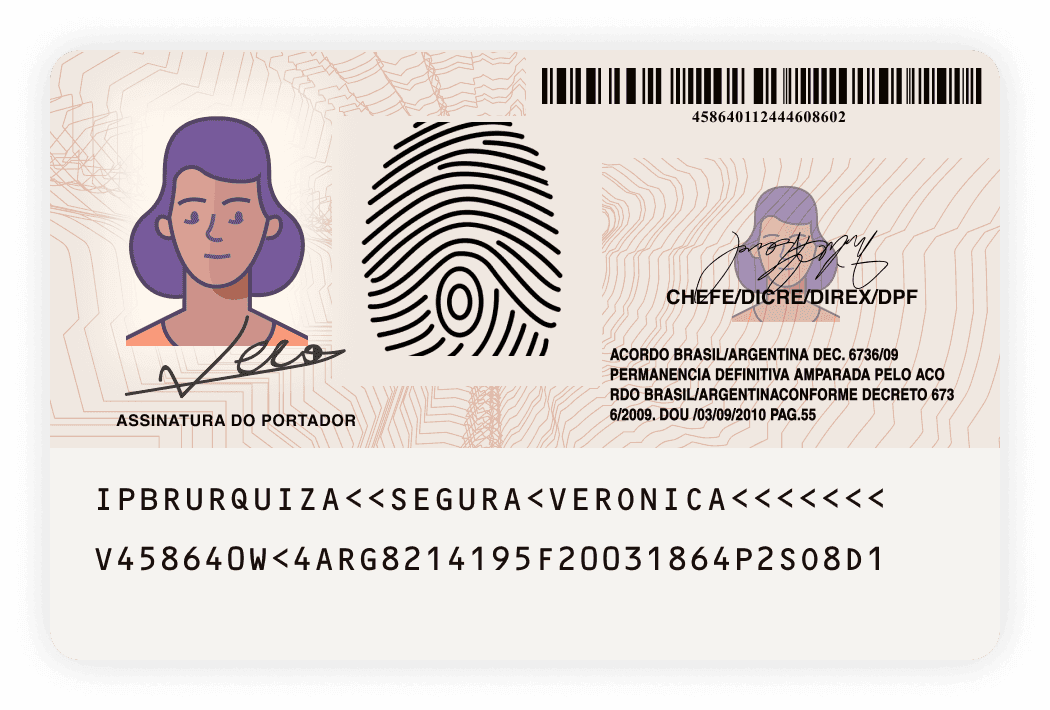
The printed text and the machine-readable zone are read. It is one of the two exceptions in the Brazilian picture.
The correspondence between the printed data and the machine-readable zone is validated, which allows the text to be checked against itself. No official Brazilian registry is queried online.
Carteira de Registro Nacional Migratório (CRNM) (Since 2017.)
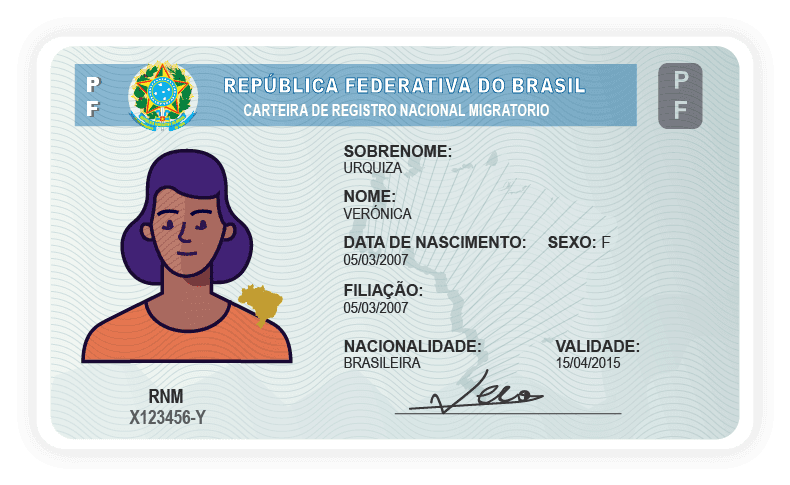
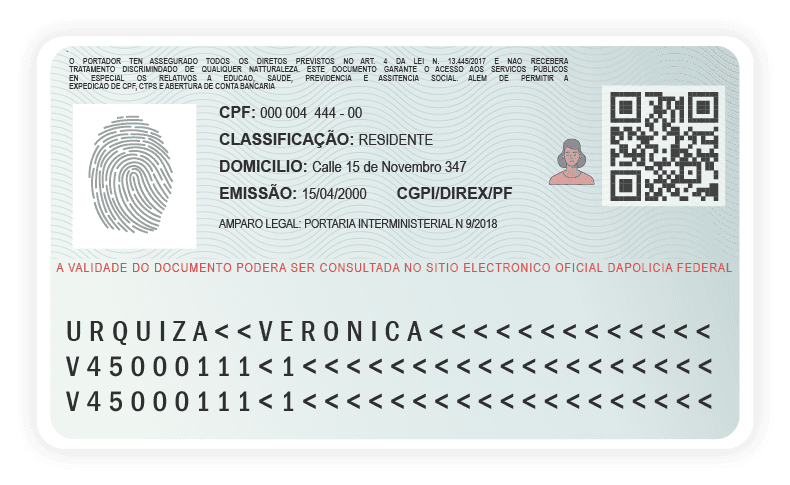
The printed text and the machine-readable zone are read. It is the second exception.
The correspondence between the printed data and the machine-readable zone is validated, which allows the text to be checked against itself. No official Brazilian registry is queried online.
Previous CNH (Between 2017 and 2022. Marked BETA.)
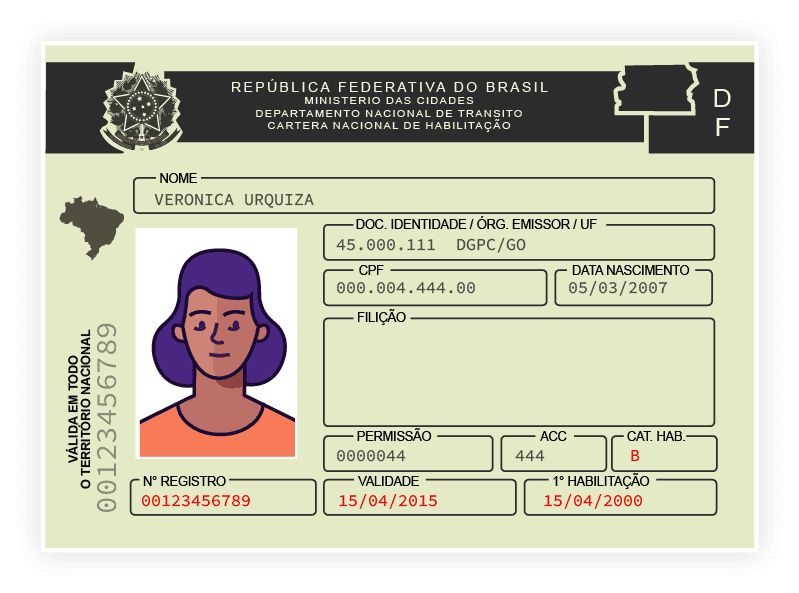
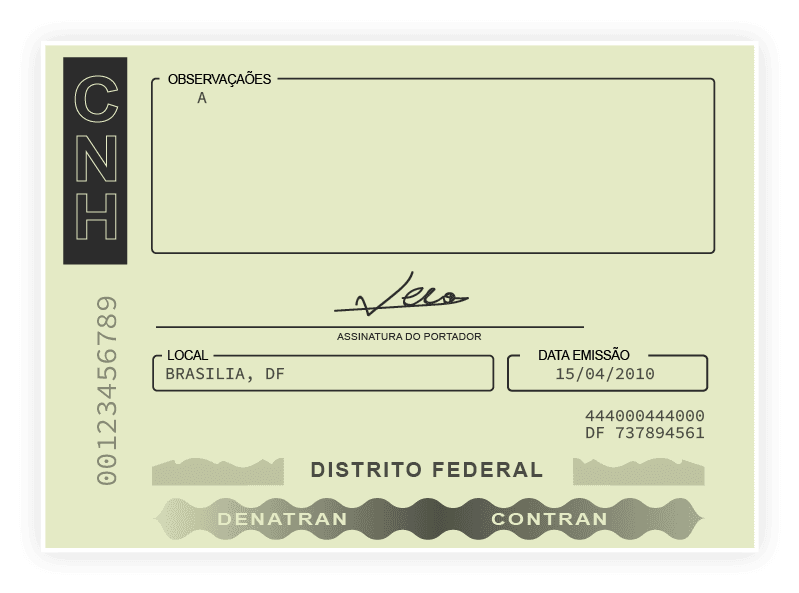
The printed text is read.
The correspondence between the printed data on the front and back is validated, with no barcode or machine-readable zone. It is marked BETA: its automated reading is not as mature as that of the other documents.
New CNH (Since 2022. Marked BETA.)
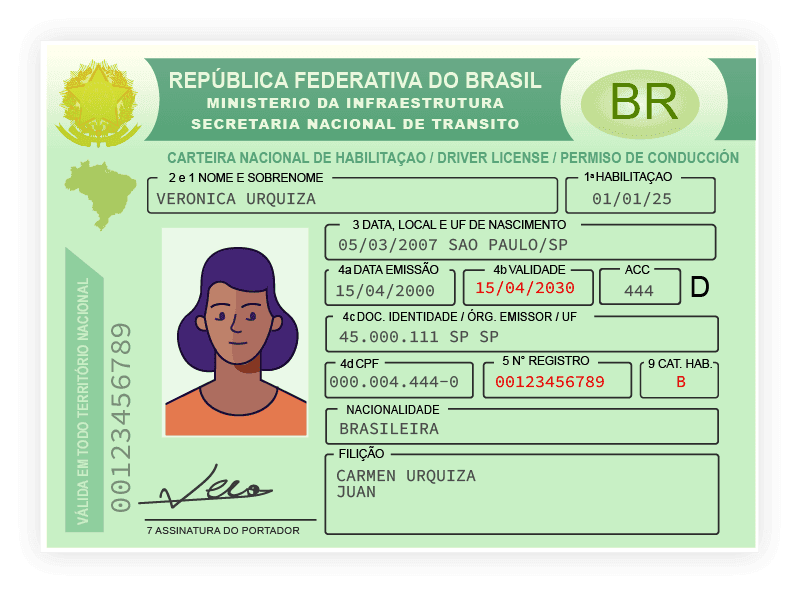
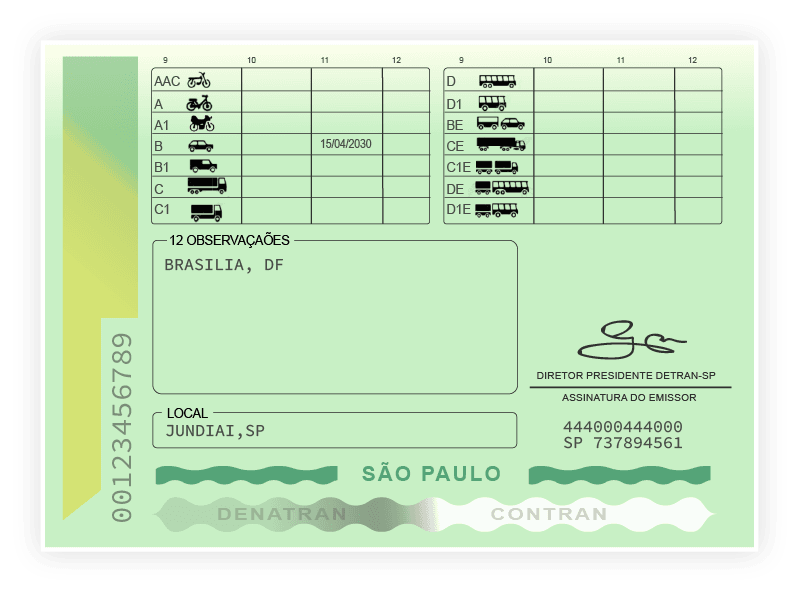
The printed text is read.
The correspondence between the printed data on the front and back is validated, with no barcode or machine-readable zone. It is marked BETA: its automated reading is not as mature as that of the other documents.
Images are reference templates with fictitious data.
- Carteira de identidade (RG): Before 2022 · Printed text · Standard
- Carteira de Identidade Nacional (CIN): Since 2022 · Printed text · Standard
- Cédula de Identidade de Estrangeiro (CIE): Until 2017 · Printed text · machine-readable zone · Standard
- Carteira de Registro Nacional Migratório (CRNM): Since 2017 · Printed text · machine-readable zone · Standard
- Previous CNH: 2017 to 2022 · Printed text · BETA
- New CNH: Since 2022 · Printed text · BETA
Two real limitations, and both change how a flow is designed.
- Most Brazilian documents carry neither a barcode nor a machine-readable zone. Reading relies on the printed text. The two foreign national cards are the exception. This matters because a barcode and a machine-readable zone are redundant elements that allow the text to be checked against itself; without them, extraction quality depends entirely on the incoming image, and the incoming image depends on the camera, the lighting and the condition of the document.
- Both driver's licenses are marked BETA. They are not as mature as the others. This is a concrete difference in a market where the driver's license is a commonly used identification document, and a flow that accepts it as equivalent will discover the difference in the exceptions queue.
What it is checked against
Within VU's coverage, verification in Brazil does not query a government source. Identification relies on reading the document presented and on biometric matching of the person, with no online check against an official Brazilian registry.
Stating this precisely matters more than leaving it ambiguous. Where that lookup exists, the check changes in nature: it moves from validating only what the document shows to checking against the registry of the authority that issued it. An institution running the same flow in Brazil and in a market with that lookup does not get the same control in both, and it is worth knowing this before designing the exceptions process.
In Brazil, this shifts the weight of the check to two places: the quality of the document reading and the quality of the biometric check. Combined with the absence of a barcode and a machine-readable zone on most documents, this is where Brazilian flow design demands more care than in a neighboring country.
What is not read, and why
Three clarifications that prevent a wrong expectation.
- No chip or contactless tag is read on any covered Brazilian document. What the coverage documents is printed text and, on the two foreign national cards, a machine-readable zone.
- No QR code is documented as a reading mechanism. Recent Brazilian documents display graphic verification elements, and the coverage does not record them as a read field. Promising it would mean promising something the process does not do.
- Brazilian coverage does not include passports. A flow that receives a Brazilian or foreign passport falls outside that coverage and needs an exception path defined in advance.
What VU automates in identity verification
VU handles the mechanical, repeatable part of the four checks, within a single flow.
- Document reading — capture and extraction of the fields according to what each Brazilian document supports: printed text and, where present, a machine-readable zone.
- Biometric matching — the captured face against the face on the document, cross-checked with the front and back of the document itself.
- Liveness detection — to establish that a real person is present at the moment of capture.
- Step orchestration — the order, retries, timeouts and what to do when a step does not complete, which is where a remote onboarding fails in practice.
- Audit trail for each step — the record of what was executed, with what result and when, which is what is shown afterward.
And what VU does not do, which matters just as much:
- It does not decide whether a person is acceptable. That is the institution's risk policy, and the rules require it of the institution, not the provider.
- It does not issue or correct documents. The carteira de identidade and the Carteira de Identidade Nacional (CIN) are issued by the state identification institutes, and the CIN uses the CPF as its single number (Decree 10.977/2022); foreign nationals' cards are issued by the Polícia Federal, and the CNH by each state's DETRAN, under SENATRAN. If a piece of data in the source registry is wrong, verification will reflect that error, not resolve it.
- It does not interpret the rules or build the regulatory file. VU produces evidence; what is kept, for how long and in what format is set by the regime and decided by the compliance team.
- It does not verify documents outside the country's coverage. A passport in a Brazilian flow needs another path.
- It does not replace consent or the privacy notice. The legal basis for processing biometric data, the stated purpose and the information given to the data subject are obligations of the controller under the LGPD.
- It does not perform transaction monitoring. Verification establishes who someone is at onboarding. What that person does afterward is another control and another page.
Use cases in Brazil
Where this problem shows up in real operations in the Brazilian market.
Opening accounts and wallets through digital channels. Remote onboarding is the standard channel for much of the system, and with it identification stopped being an employee looking at a document and became a process that has to prove itself on its own.
Authentication before each data-sharing consent. In open finance, identity is not verified once: it is invoked every time the customer authorizes something.
Documents without a redundant reading element. Most Brazilian documents in circulation rely on printed text, so the quality of the captured image stops being a user experience detail and becomes an accuracy requirement.
Driver's license used as an identification document. It is a commonly used document at the counter and in digital channels, and its automated reading is not as mature as that of the others.
Resident foreign nationals. They present identity cards with a machine-readable zone, which are the exception in the picture, and they account for a disproportionate share of the exception paths.
Frequently asked questions
The identification documents the institution accepts, within what the verification process can read automatically. In Brazil, different generations coexist at the same time, from older identity cards (carteira de identidade) to the most recent Carteira de Identidade Nacional (CIN), plus identity cards for foreign nationals and the driver's license (carteira de habilitação). A serious process has to account for every document it can receive in practice, not just the newest one. What differs between them is not their legal value but which elements each one carries for automated reading, which determines the accuracy of the extraction.
No. Identity verification establishes that a person is who they claim to be and produces the evidence of that check. KYC is the broader duty: beyond identifying, it includes qualifying the customer, classifying them by risk, keeping the record up to date throughout the relationship and retaining that information in an auditable way. Identity verification is the first link in that duty and what produces the proof, but a process can verify flawlessly and still fail to meet KYC.
Today, VU's verification in Brazil does not query an official database. Checking against the issuing authority's registry is different from validating what the document shows: the first asks whether that person exists as declared, the second only confirms that the document is consistent with itself. What is resolved without that lookup is the full reading of the document, validation of its elements and biometric matching of the person, with liveness detection at capture.
It depends on the document. Most Brazilian documents in circulation rely on printed text, with no barcode and no machine-readable zone. Cards for foreign nationals are the exception and carry a machine-readable zone. The practical consequence is direct: without redundant elements that allow the text to be checked against itself, capture quality determines reading quality, and the flow design has to handle lighting, framing and retries with more care than in markets with more instrumented documents.
An image of the document resolves only one of the four checks, and only partly. It allows the data to be read, but it says nothing about whether the sender is the holder, whether there is a real person on the other side at that moment, or whether the data are consistent with any source. A process built on a photo sent through a messaging app is the easiest scenario to attack: the image may come from a stolen document, a screenshot or a purchased file.
Sources
- Decree 10.977/2022 · carteira de identidade (Planalto)
- BCB Circular 3.978/2020 · AML/CFT policy, procedures and controls
- CMN/BCB Joint Resolution 1/2020 · open finance
- Lei 13.709/2018 · LGPD, Lei Geral de Proteção de Dados (Planalto)
- BCB · Banco Central do Brasil
- ANPD · Autoridade Nacional de Proteção de Dados
- Gov.br · Carteira de Identidade Nacional