What identity verification requires in Colombia
The obligation does not come from a rule about documents: it comes from SARLAFT, the system the Superintendencia Financiera de Colombia imposes on the entities it supervises to manage the risk of money laundering and terrorist financing. That system requires knowing the customer before onboarding them and recording how they came to be known. Verifying identity is the first link in that duty, and the one that produces the evidence on which all the others rest.
Real-sector companies answer to SAGRILAFT, under the Superintendencia de Sociedades. The supervisor changes and the thresholds change; the identity check at onboarding does not change in nature.
In Colombia the document is the cédula and the body that records people's identity is the Registraduría Nacional del Estado Civil (the national civil registry). That distinction sets the quality ceiling of any verification: the document is a printed claim, and the registry is what that claim is checked against.
Translated into what a process has to settle, these are four distinct checks, and all four have to leave a record.
- That the document is authentic — full reading of the document presented and validation of its security features, not just the number.
- That the person on the document is the one on the other side — biometric matching between the captured face and the one on the document.
- That this person is present and alive — liveness detection, which is what separates a real face from a photo, a recorded video or a synthetic face.
- That the declared data is consistent — cross-checking against the available sources and against the applicable restricted lists.
All four produce evidence. In SARLAFT's vocabulary that verification belongs to the control stage, and the evidence it leaves is what later feeds monitoring. A process that verifies well and does not record how it verified leaves the entity with nothing to show when the supervisor asks about a specific case.
The Colombian documents that are read
Colombia has three documents covered, and the difference between them is not cosmetic: in December 2020 the reading mechanism on the back changed. An onboarding flow can receive a yellow cédula and a blue one on the same day, and what is read from each one is not the same.
Yellow cédula (In force between 2000 and 2020.)
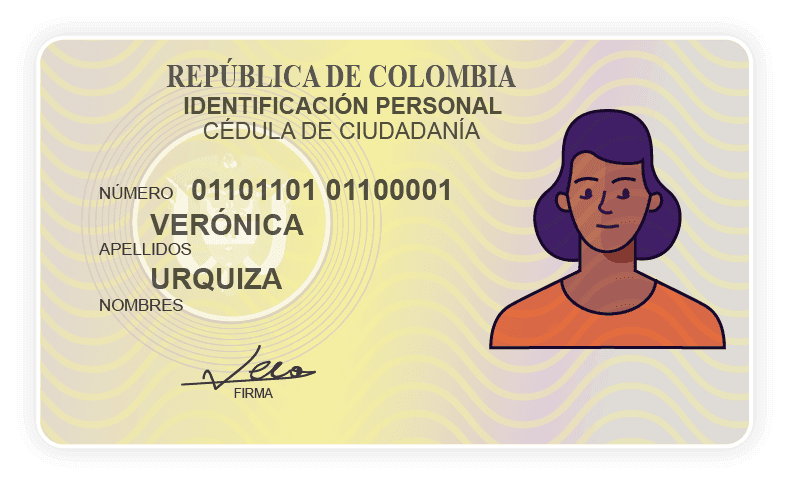
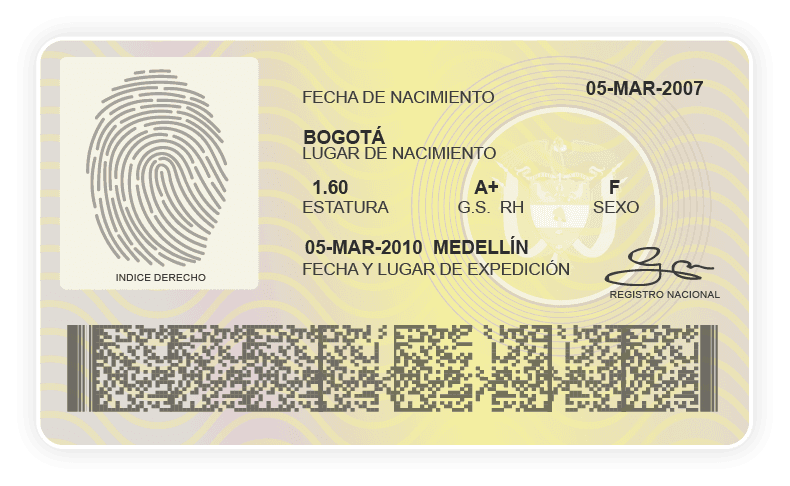
The printed text and the barcode are read. It is the only one of the three documents that is read this way.
The match between the printed data and the barcode on the back is validated, and the document is checked against the Registraduría's registry. It is the generation that was issued for twenty years and the one that appears most in old portfolios.
Blue cédula (In force since December 2020.)
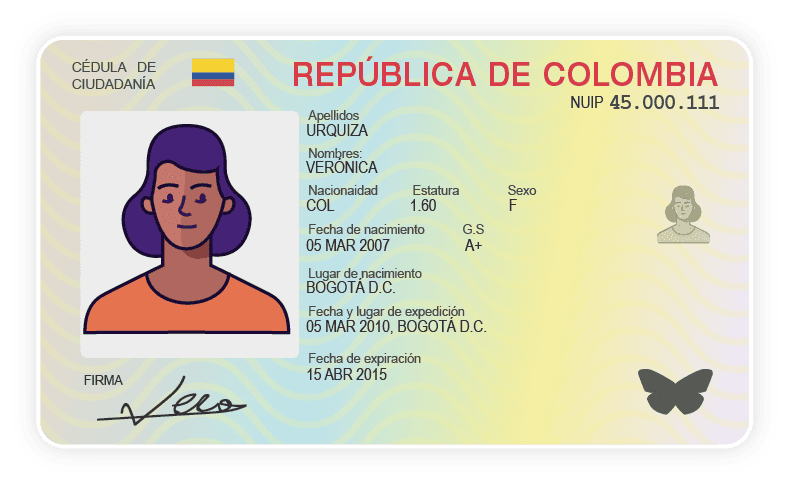
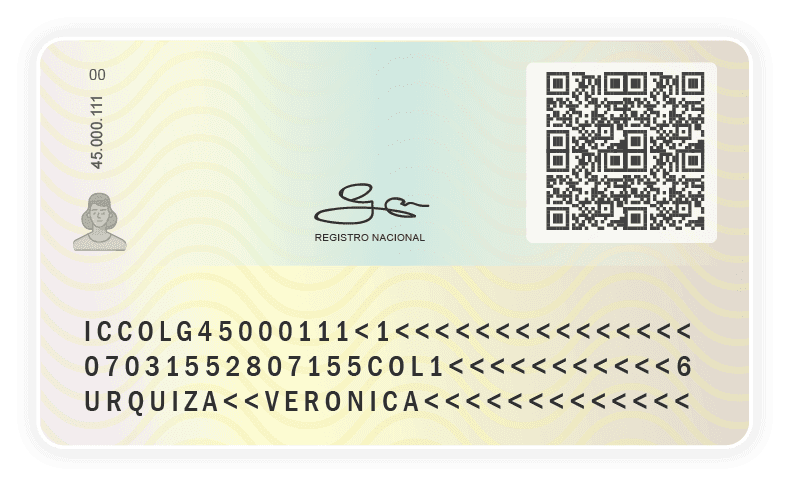
The printed text and the machine-readable zone are read. The barcode is no longer the mechanism on the back.
The match between the printed data and the machine-readable zone on the back is validated, and the document is checked against the Registraduría's registry. It is the generation that is growing in current flows.
Cédula de extranjería
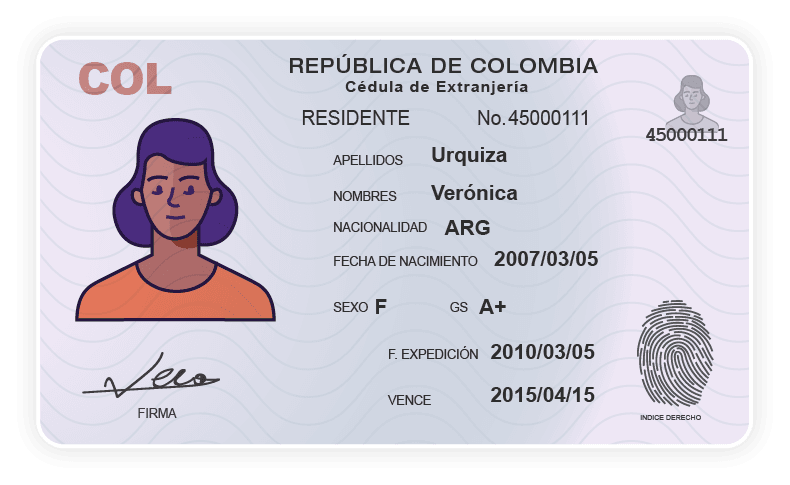
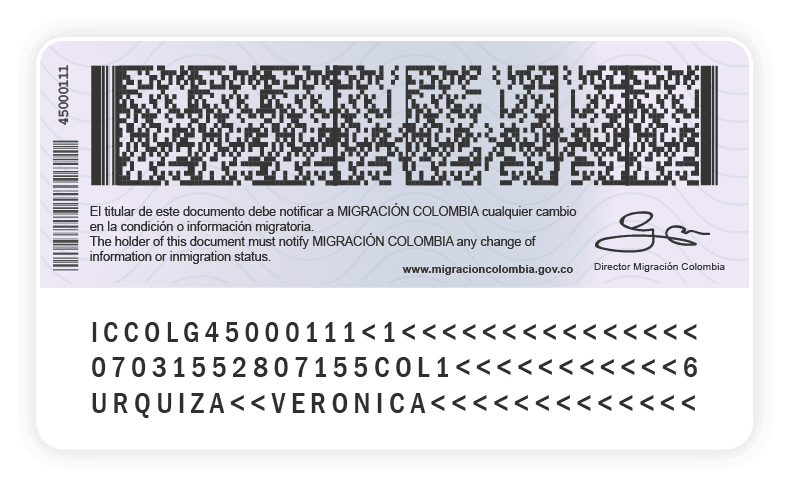
The printed text and the machine-readable zone are read, the same as the blue cédula. It is the document of resident foreign nationals, and its presence in the coverage matters because a Colombian flow that only accounts for the cédula de ciudadanía routes that entire population to manual review.
The match between the printed data and the machine-readable zone is validated, with the same reading scheme as the blue cédula, and the document is checked against a government source. It is the document of resident foreign nationals.
Images are reference templates with fictitious data.
- Yellow cédula: 2000 to 2020 · Printed text · barcode
- Blue cédula: Since December 2020 · Printed text · machine-readable zone
- Cédula de extranjería: Validity tied to the visa · Printed text · machine-readable zone
The difference between generations is the most important design decision in the Colombian flow. It is not an implementation detail: they are two different reading mechanisms, and a process that supports only one fails with half of the document base. The yellow cédula was issued for twenty years and does not disappear because a new one came out; the blue one is the one that is growing. Supporting both is not an optimization, it is the requirement.
The three mechanisms each have their own glossary entry: OCR for printed text, PDF417 for the barcode and MRZ for the machine-readable zone.
What it is checked against
In Colombia, verification queries a government source. In practice that changes the nature of the check: it stops merely validating what the document shows and moves on to checking against an official record. That query covers both generations of the cédula de ciudadanía and the cédula de extranjería.
The difference matters when operating in several countries. That query does not exist in every market, and where it does not exist verification relies only on the document presented and on biometrics. A team running the same flow in several markets is not buying the same control in each, and it is worth knowing that before designing the exception process.
For an entity supervised by the Superintendencia Financiera the effect on the evidence is direct: checking against the registry answers whether that person exists as declared, while validating the document only checks that the card is consistent with itself. They are two claims of different strength before a supervisor.
What is not read, and why
Three clarifications that prevent a mistaken expectation.
- In Colombia there is no element that is present but unreadable. Colombian coverage does not document any field that exists on the document and cannot be read. The only change between generations is the one already described: a barcode on the yellow one, a machine-readable zone on the blue one.
- Colombian coverage is cédula, and cédula only. Cédula de ciudadanía in its two generations and cédula de extranjería. It does not include the Colombian passport, it does not include the tarjeta de identidad (the identity card for minors), and it does not include documents from other countries. A flow that receives any of those falls outside the coverage and needs an exception route defined in advance.
- Colombian coverage does not include chip reading.
What VU automates in identity verification
VU handles the mechanical, repeatable part of the four checks, within a single flow.
- Document reading — capture and extraction of the fields according to what each generation of cédula supports: printed text, barcode or machine-readable zone.
- Biometric matching — the captured face against the one on the document, with the front and back of the document itself cross-checked.
- Liveness detection — to establish that there is a real, present person at the moment of capture.
- Orchestration of the steps — the order, retries, timeouts and what to do when a step does not complete, which is where a digital onboarding breaks down in practice.
- Trail of each step — the record of what ran, with what result and when, which is what gets shown later.
And what VU does not do, which matters just as much:
- It does not decide whether a person is acceptable. That is the supervised entity's risk policy, and SARLAFT requires it of the entity, not of its provider.
- It does not issue or correct documents. That belongs to the Registraduría. If a piece of data in the registry is wrong, the verification will reflect that error, not fix it.
- It does not interpret the rules or assemble the customer file. VU produces evidence; what is retained, for how long and in what format is defined by the system and decided by the compliance officer.
- It does not verify documents outside the country's coverage. A passport or a tarjeta de identidad in a Colombian flow needs another route.
- It does not do transaction monitoring. Verification establishes who someone is at onboarding. What that person does afterwards is SARLAFT's monitoring stage, and it is another page.
Use cases in Colombia
Where this problem shows up in the real operation of the Colombian market.
Account and wallet opening through digital channels. Remote onboarding is today the default channel for much of the system, and with it identification went from an employee looking at a cédula to a process that has to prove itself.
Two generations of cédula coexisting with two different reading mechanisms. A flow that only accounts for one of the two starts piling up manual exceptions, and the cost shows up in the support team before it does in compliance.
Resident foreign nationals. The cédula de extranjería is a commonplace document in Colombian operations, and a process that treats it as an exception turns an entire population into a review queue.
Updating the files of customers onboarded in person. People signed up years ago, with paper evidence or no useful evidence, who have to be verified again without forcing them to go to a branch.
Real-sector companies under SAGRILAFT. They come to identity verification with no prior compliance team and with a different supervisor, so the question is not what to buy but how much process is proportionate.
Frequently asked questions
The cédula, in the generations that are valid at the time of verification, and the cédula de extranjería for resident foreign nationals. In Colombia the yellow cédula, issued for two decades, coexists with the blue one, which replaced it at the end of 2020, and a serious process has to account for both, not just the newest. What changes between generations is not the value of the document but which elements it carries for automatic reading, which is why the flow is designed around the real document base and not the ideal one.
It depends on the generation. The yellow cédula carries printed text and a barcode on the back, and both are read. The blue cédula replaces that barcode with a machine-readable zone, the same mechanism the cédula de extranjería uses. The practical consequence is the most important one on this page: a flow that assumes a single reading mechanism for every Colombian cédula will fail with one of the two generations, and both are in circulation at the same time.
No. Identity verification establishes that a person is who they claim to be and produces the evidence of that check. KYC is the broader duty SARLAFT requires: besides identifying, it includes understanding the customer's profile, scaling diligence by their risk, keeping the information up to date throughout the relationship and retaining the customer file. Identity verification is the first link in that duty and the one that produces the proof, but a process can verify flawlessly and still fail to comply with SARLAFT.
The Registraduría Nacional del Estado Civil is the body that records the identity of people in Colombia and issues the cédula, so it is the reference against which an identity is attested in the country. Checking against the issuer's registry is different from validating what the document shows: the first asks whether that person exists as declared, the second only checks that the card is consistent with itself.
An image of the document settles only one of the four checks, and only partly. It makes it possible to read the data, but it says nothing about whether the sender is the holder, whether there is a real person on the other side at that moment, or whether the data is consistent with any source. A process built on a photo sent over a messaging app is the easiest scenario to attack there is: the image can be of a stolen document, a screenshot or a purchased file.
Sources
- SARLAFT · SFC Circular Básica Jurídica, Part I, Title IV, Chapter IV
- SAGRILAFT · Chapter X, Supersociedades Circular Básica Jurídica
- SFC · Superintendencia Financiera de Colombia (financial supervisor)
- Superintendencia de Sociedades
- UIAF · Unidad de Información y Análisis Financiero (Colombia's FIU)
- Cancillería (Foreign Ministry) · Cédula de extranjería