What identity verification requires in Guatemala
The obligation does not come from a rule about documents: it comes from the regime for preventing money laundering and terrorist financing requiring that the customer be known before they are allowed to transact. The body that receives the reports under that regime and verifies that obligated persons comply is the IVE, the Intendencia de Verificación Especial, which operates within the scope of the Superintendencia de Bancos. And when the obligated person is an entity of the financial system, the SIB also supervises how it did so. Verifying identity is the first link in that duty, and the one that produces the evidence on which all the others rest.
In Guatemala the document is the DPI, the Documento Personal de Identificación, and the body that issues it is RENAP, the Registro Nacional de las Personas (national registry of persons). That distinction sets the quality ceiling of any verification: the document is a printed claim, and the RENAP record is what that claim is checked against.
Translated into what a process has to settle, these are four distinct checks, and all four have to leave a record.
- That the document is authentic — full reading of the document presented and validation of its security features, not just the number.
- That the person on the document is the one on the other side — biometric matching between the captured face and the one on the document.
- That this person is present and alive — liveness detection, which is what separates a real face from a photo, a recorded video or a synthetic face.
- That the declared data is consistent — cross-checking against the available sources and against the applicable restricted lists.
All four produce evidence. That evidence is the customer file, and the customer file is what the supervisor looks at.
The Guatemalan document that is read
Guatemala has a single document covered, and that is the most important difference between its flow and that of most of its neighbors.
Documento personal de identificación (Current since July 2009.)
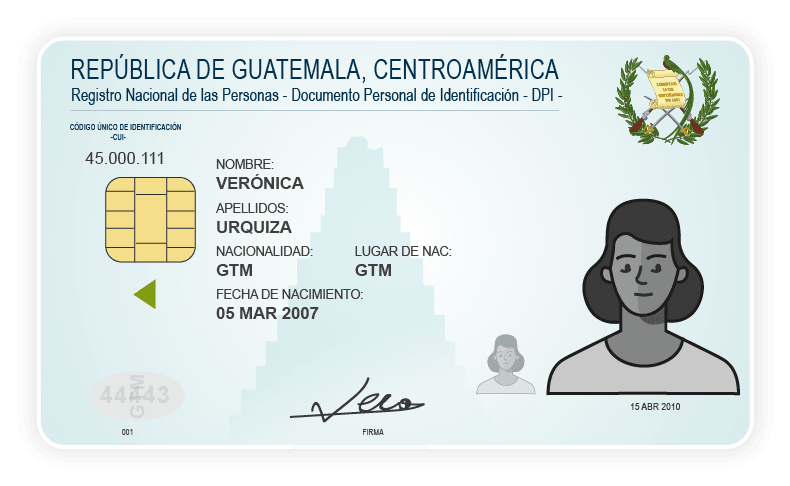
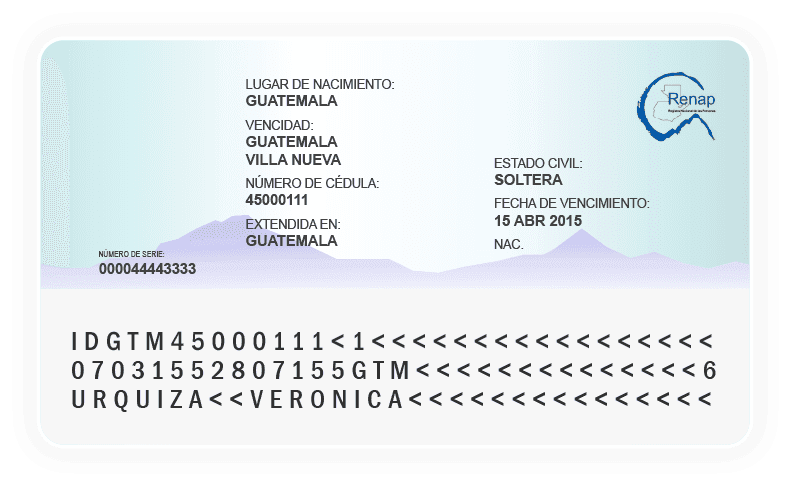
Two mechanisms are read: the printed text, through optical character recognition, and the machine-readable zone, the document's encoded lines designed for automated reading. Having both enables an internal consistency check, comparing what is printed against what is encoded, without leaving the document.
The match between the printed text and the machine-readable zone of the DPI is validated, and the verification queries a government source. The coverage does not include reading of a barcode, QR code or chip.
Images are reference templates with fictitious data.
- Documento personal de identificación: Since July 2009 · Printed text · machine-readable zone
A one-piece document landscape does not simplify verification: it concentrates it. It is worth saying precisely, because it is the design decision that organizes an entire Guatemalan flow.
- What is gained. There is no need to branch by generation. In countries with four or five documents coexisting, a good part of the engineering work and of the exception queue goes into deciding which version arrived and what can be read from it. Here that branch does not exist, and with it an entire family of errors disappears.
- What moves to another place. All the weight shifts to two other points. The first is the quality of the reading on that single piece: if the DPI arrives worn, poorly lit or with a deteriorated machine-readable zone, there is no alternative document to fall back on. The second is the exception route for everything that is not a DPI, which in Guatemala is not a rare textbook case but the only detour that exists.
Put another way: a single document makes the happy path simpler and the edge case more critical. A flow that takes advantage of the former and does not design the latter ends up with its entire exception queue concentrated in one place.
What it is checked against
Checking against the record of the body that issued the document is different from validating what the document shows. A DPI is a printed claim: it states a name, a number and a date. Asking the registry whether that person exists as declared is another check, a stronger one, and it is what separates a process that reviews a piece of plastic from one that confirms an identity.
In Guatemala, DPI verification queries a government source. In practice that changes the nature of the check: it stops merely validating what the document shows and adds a check against an official source.
What is not read, and why
Three clarifications that prevent a mistaken expectation.
- The coverage documents two reading mechanisms, not four. Printed text and machine-readable zone. The barcode and the QR code are not listed as reading mechanisms for the DPI. A flow designed on the assumption that any document in the region carries a two-dimensional code to be scanned is going to ask the user for something it then does not use.
- Guatemalan coverage is for the DPI, and only the DPI. It does not include the Guatemalan passport or foreign nationals' documents. With a single covered document, that exception route stops being a detail and becomes a product decision: it has to be defined before going live, not when the first case appears.
- The DPI's chip is not read. The document has a chip, but Guatemalan coverage does not include reading it.
What VU automates in identity verification
VU handles the mechanical, repeatable part of the four checks, within a single flow.
- Document reading — capture and extraction of the fields according to what the Guatemalan document supports: the printed text and the machine-readable zone, checked against each other.
- Biometric matching — the captured face against the one on the document, with the front and back of the document itself cross-checked.
- Liveness detection — to establish that there is a real, present person at the moment of capture.
- Orchestration of the steps — the order, retries, timeouts and what to do when a step does not complete, which is where a digital sign-up breaks down in practice.
- Trail of each step — the record of what ran, with what result and when, which is what gets shown later.
And what VU does not do, which matters just as much:
- It does not decide whether a person is acceptable. That is the obligated person's risk policy, and the law requires it of them, not of their provider.
- It does not issue or correct documents. That belongs to RENAP. If a piece of data in the registry is wrong, the verification will reflect that error, not fix it.
- It does not interpret the law or assemble the regulatory customer file. VU produces evidence; what is retained, for how long and in what format is defined by the regime and decided by the compliance team.
- It does not verify documents that are not in the country's coverage. A Guatemalan passport or a foreign document in a Guatemalan flow needs another route, and in this country that route is the only exception that exists.
- It does not do transaction monitoring. Verification establishes who someone is at sign-up. What that person does afterwards is another control and another page.
Use cases in Guatemala
Where this problem shows up in the real operation of the Guatemalan market.
Remittances and cross-border payments. They are a central part of the country's money movement, with frequent transactions, small amounts and an identification that has to be resolved quickly and still leave evidence.
Savings and credit cooperatives and microfinance institutions. They share the obligation with banks but not their scale or their budget, so the question is not what to buy but how much process is proportionate.
Wallets and mobile banking with remote sign-up. Identification went from an employee looking at a document to a process that has to prove itself, over a channel that is also the growth channel.
Documents outside coverage. Foreign nationals, resident or in transit, who present something that is not a DPI. With a single document covered, this is the main detour in the flow and not a rare case.
DPIs that are deteriorated or captured in poor conditions. A document that has been current for more than a decade arrives worn, and the quality of the capture depends on the device and the connectivity of whoever presents it.
Files of customers onboarded in person. People signed up when the standard of evidence was different, who have to be verified again without forcing them to go to a branch.
Frequently asked questions
The Documento Personal de Identificación, the DPI, which RENAP issues to Guatemalans and to domiciled foreign nationals. Unlike other markets in the region, where several generations of document coexist at the same time, in Guatemala the automated flow is designed around a single piece. That simplifies the engineering of the common case and makes the route for everything else more important: a passport, a foreign national's document or a DPI in poor condition need an exit defined in advance, because there is no second covered document to fall back on.
No. Identity verification establishes that a person is who they claim to be and produces the evidence of that check. KYC is the broader duty of the prevention regime: besides identifying, it includes understanding the customer's profile, scaling diligence by their risk, keeping the information up to date throughout the relationship and retaining the customer file. Identity verification is the first link in that duty and the one that produces the proof, but a process can verify flawlessly and still fail to comply with KYC.
RENAP is the body that records the identity of people in Guatemala and issues the DPI, so it is the reference against which an identity is attested in the country. Checking against an official source is different from validating what the document shows: the former asks whether that person exists as declared, the latter only checks that the plastic is consistent with itself. In Guatemala, DPI verification queries a government source. It is worth keeping in mind when designing the exceptions process, because it changes what can be done with a doubtful case.
Two elements: the printed text and the machine-readable zone, those encoded lines designed for automated reading. Both are read and checked against each other, which is the cheapest consistency check there is within the document itself. What the coverage does not document is the reading of a barcode or of a QR code, so a flow that assumes every document in the region carries a scannable two-dimensional code does not find that mechanism on the DPI and ends up asking for a capture it then makes no use of.
An image of the document settles only one of the four checks, and only partly. It makes it possible to read the data, but it says nothing about whether the sender is the holder, whether there is a real person on the other side at that moment, or whether the data is consistent with any source. A process built on a photo sent over a messaging app is the easiest scenario to attack there is: the image can be of a stolen document, a screenshot or a purchased file.