What identity verification requires in Mexico
The obligation does not come from a rule about documents: it comes from the anti-money laundering law requiring that the customer be identified and that a customer file be built with that identification, and from the CNBV verifying the same in the entities of the financial system. Verifying identity is the first link in that duty, and the one that produces the evidence on which all the others rest.
That duty has a threshold, and it is lower than the reporting one. It is the most common confusion in the Mexican regime: falling below the threshold that triggers the report does not release anyone from identifying. The customer file is built all the same, long before there is anything to report.
Translated into what a process has to settle, these are four distinct checks, and all four have to leave a record.
- That the document is authentic — full reading of the credencial presented and validation of its elements, not just the number.
- That the person on the document is the one on the other side — biometric matching between the captured face and the one on the document.
- That this person is present and alive — liveness detection, which is what separates a real face from a photo, a recorded video or a synthetic face.
- That the declared data is consistent — cross-checking against the available sources and against the applicable restricted lists.
All four produce evidence. That evidence is the customer file, and the customer file is what the authority looks at.
The Mexican documents that are read
Mexico has five documents covered, and they are not all credenciales de elector (voter ID cards). They coexist on the street at the same time, and what is read from each one is not the same: two of them rely solely on the printed text.
INE credencial para votar (voter ID card) (Covered since November 2013.)
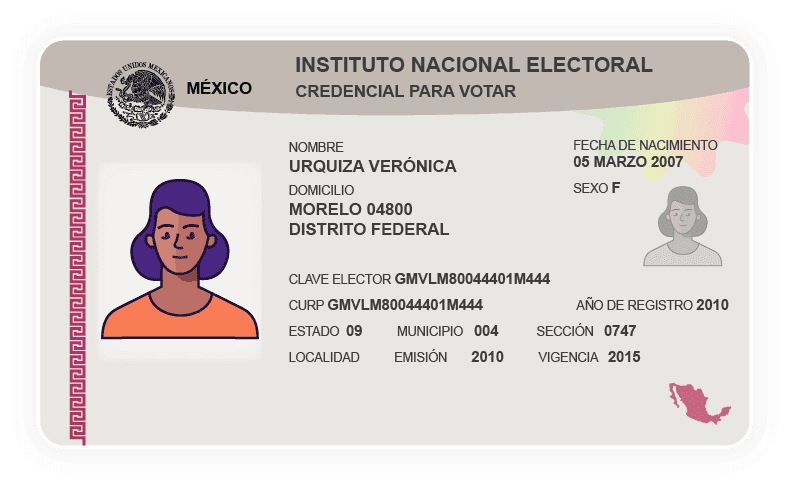
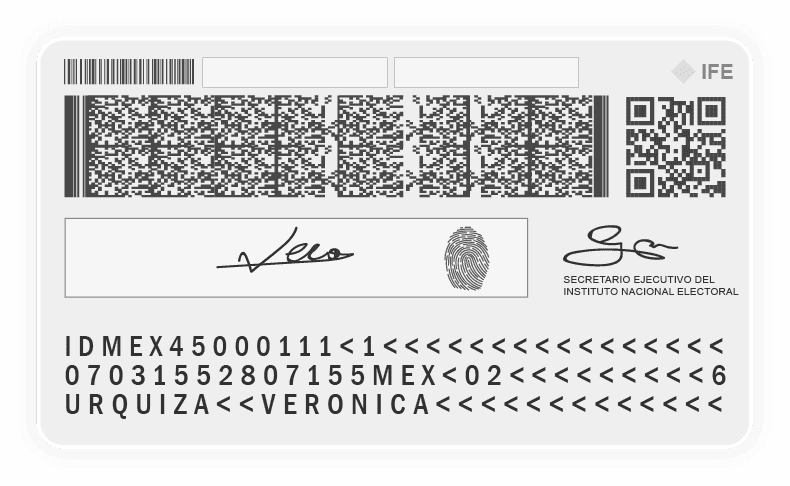
The printed text and the machine-readable zone are read. The barcode on the back is not read, and the reason why is a few lines below.
The match between the printed data and the MRZ is validated. The barcode on the back is encrypted and is not read, so it is not part of the validation.
IFE credencial (Covered since September 2008.)
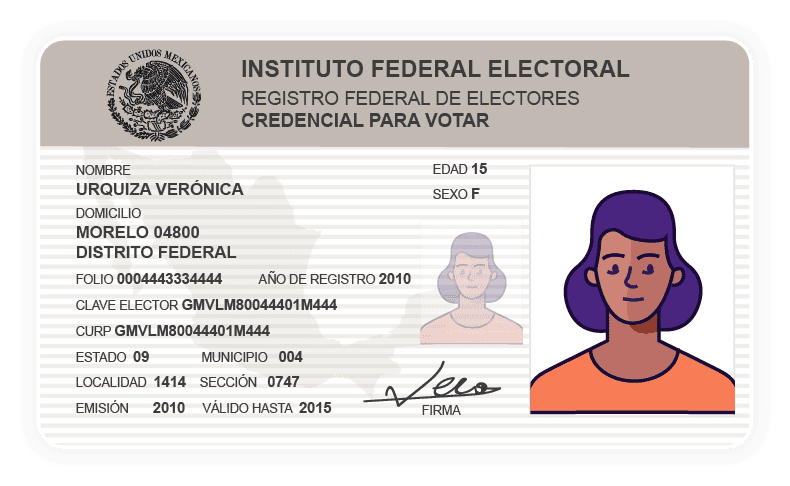
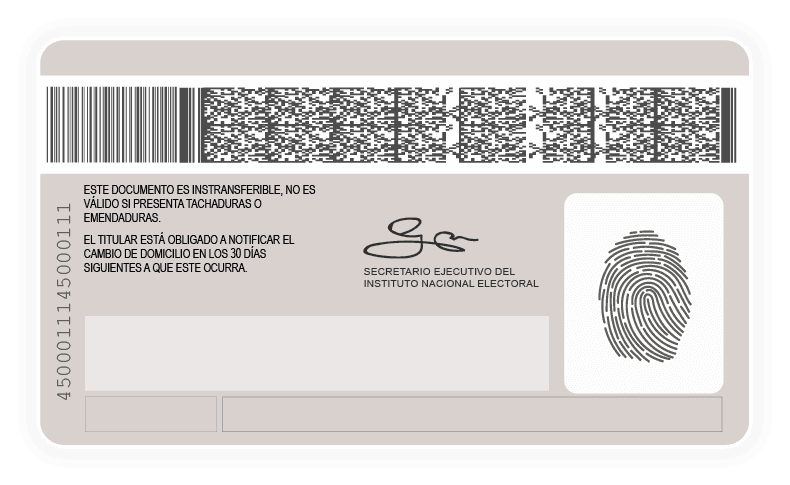
It is the previous generation of the credencial de elector (voter ID card) and still shows up in sign-up flows. Only the printed text is read: it does not provide a machine-readable zone, and its barcode is not read either. It is the most demanding credencial of the five for an automatic process, because the whole reading rests on a single mechanism.
Only the printed text is validated: it does not carry an MRZ and its barcode is not read, so the whole validation depends on capture quality.
Credencial de residente permanente (permanent resident card)
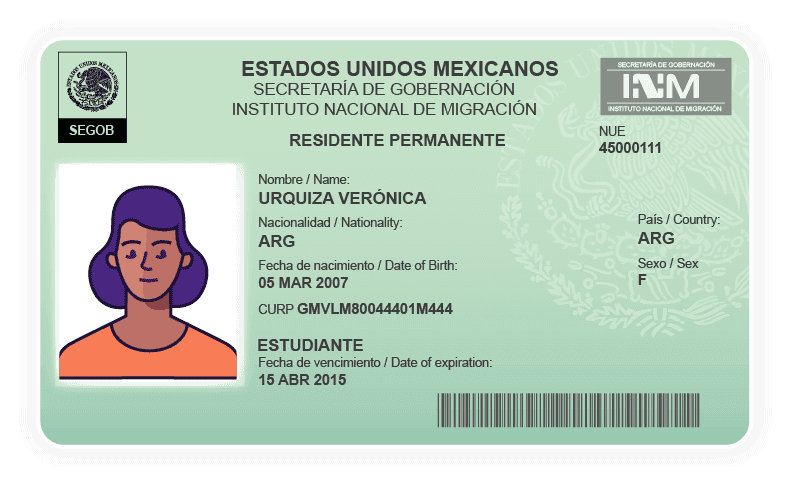
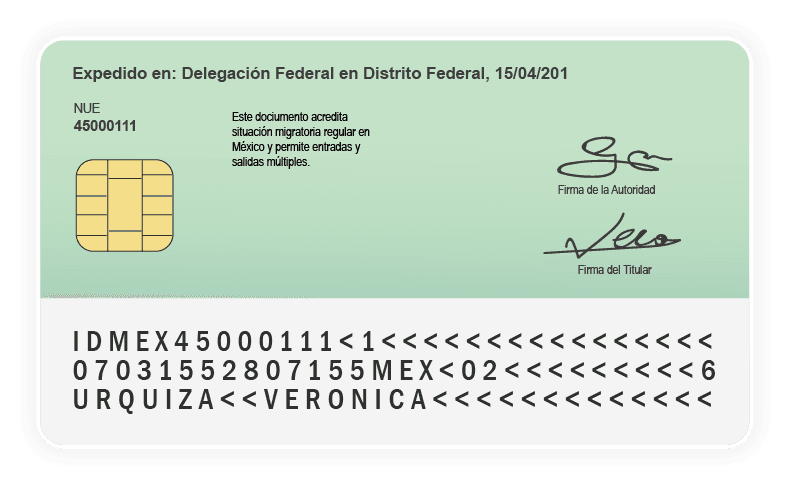
It is the document of foreign nationals residing in Mexico, and the only one of the five whose barcode is read, in addition to the printed text and the machine-readable zone. It is the most complete credencial in the Mexican set in number of readable elements.
The match between the printed data, the barcode and the MRZ is validated. It is the document with the most readable elements of the five covered.
Cédula profesional (professional license)
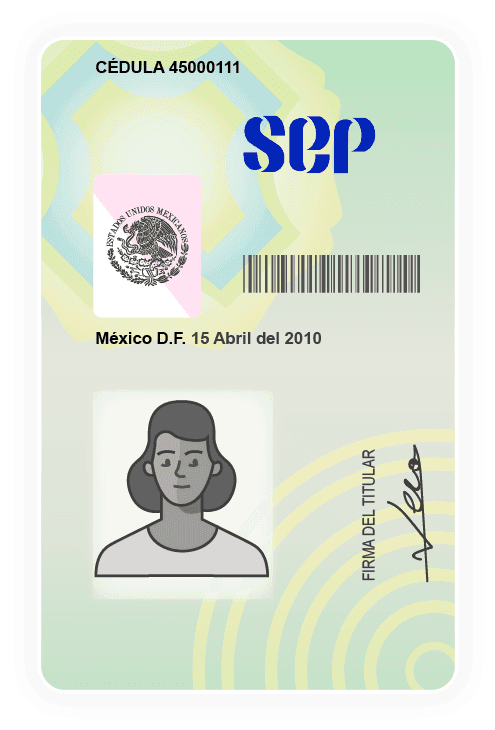
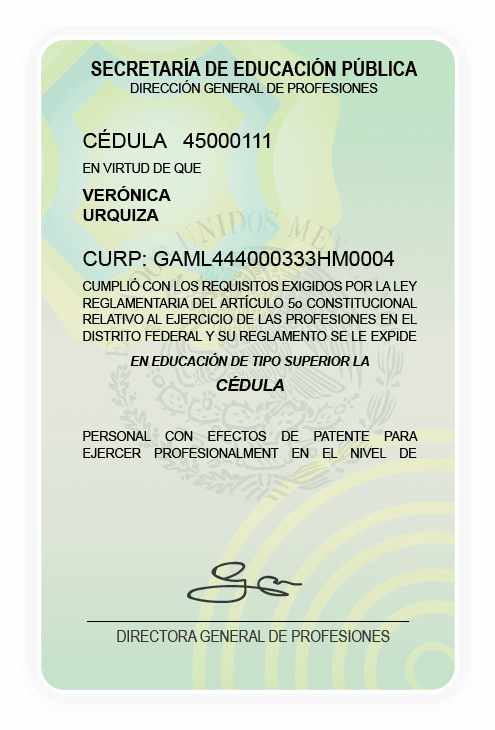
The printed text is read. Like the IFE credencial, it does not provide a machine-readable zone, so automatic reading rests on a single mechanism.
The printed text is validated, which is its only reading mechanism: it does not provide an MRZ, so extraction depends entirely on capture quality.
Mexican passport (In force since 2020.)
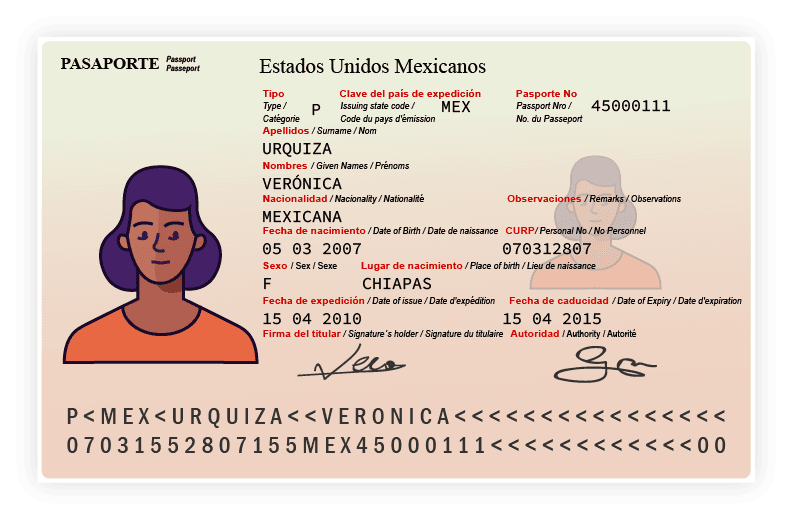
The machine-readable zone is read, which is the internationally standardized element of the data page.
The MRZ on the data page, the internationally standardized element, is validated. This guide does not claim chip reading.
Images are reference templates with fictitious data.
- INE credencial para votar (voter ID card): Covered since November 2013 · Printed text · machine-readable zone
- IFE credencial: Covered since September 2008 · Printed text
- Credencial de residente permanente (permanent resident card): Not stated in the coverage · Printed text · barcode · machine-readable zone
- Cédula profesional (professional license): Not stated in the coverage · Printed text
- Mexican passport: Since 2020 · Machine-readable zone
The design consequence is concrete: a Mexican flow that assumes all credenciales carry the same readable elements starts piling up exceptions with the two that only have printed text, which are also the oldest and the ones that arrive with the worst capture quality.
What verification relies on
In Mexico, VU's support is for a document-centered identity verification flow. It relies on what the document presented shows and on biometric matching of the person presenting it.
For design, that has a direct consequence: the quality of the capture and the readable elements of each credencial define how far the check goes. It is worth knowing this before designing the exceptions process and the manual review threshold.
What is not read, and why
Three clarifications that prevent a wrong expectation, and that a technical team appreciates sooner rather than later.
- The barcode on the INE credencial and on the IFE one is not read, because it is encrypted. The element exists, it is printed on the back and it is not readable by a third party. Identification relies on the printed text and, on the INE credencial, on the machine-readable zone. A flow designed on the assumption that the back of a credencial de elector (voter ID card) delivers structured data fails with the two most common credenciales in the country.
- The IFE credencial and the cédula profesional (professional license) depend on a single mechanism. With no machine-readable zone, all extraction comes from the printed text, so capture quality weighs far more than in the other three documents and the exception route has to exist from day one.
- This page does not claim chip reading.
What VU automates in identity verification
VU handles the mechanical, repeatable part of the four checks, within a single flow.
- Document reading — capture and extraction of the fields according to what each Mexican credencial supports: printed text, barcode or machine-readable zone, depending on the document.
- Biometric matching — the captured face against the one on the document, with the front and back of the document itself cross-checked.
- Liveness detection — to establish that there is a real, present person at the moment of capture.
- Orchestration of the steps — the order, retries, timeouts and what to do when a step does not complete, which is where a digital sign-up breaks down in practice.
- Trail of each step — the record of what ran, with what result and when, which is what gets shown later when the authority asks how that customer was identified.
And what VU does not do, which matters just as much:
- It does not decide whether a person is acceptable. That is the risk policy of whoever carries out the activity, and the law requires it of them, not of their provider.
- It does not issue or correct documents. If a piece of data on the document presented is wrong, the verification will reflect that error, not fix it.
- It does not interpret the law or assemble the regulatory customer file. VU produces evidence; what is retained, for how long and in what format is defined by the regime and decided by the compliance team.
- It does not verify documents outside the country's coverage. A foreign credencial other than the ones covered needs another route.
- It does not do transaction monitoring. Verification establishes who someone is at sign-up. What that person does afterwards is another control and another page.
Use cases in Mexico
Where this problem shows up in the real operation of the Mexican market.
Customer sign-up at financial technology institutions and banks. The digital channel is the fastest-growing one, and identification went from an account officer looking at a credencial to a process that has to prove itself.
Vulnerable activities outside the financial system. Notary offices, real estate agencies, vehicle dealers and pawnshops build identification files with no prior compliance team and with low but constant volume.
Two generations of the credencial de elector (voter ID card) coexisting. A flow that only accounts for the newest credencial starts piling up manual exceptions, and the cost shows up in the support team before it does in compliance.
Resident foreign nationals. The credencial de residente permanente (permanent resident card) shows up in payroll, remittance and leasing portfolios, and it is the document most often forgotten when designing the flow.
Updating the files of long-standing customers. People identified years ago, with paper records or with evidence that does not withstand a review today, who have to be verified again without forcing them to go to a branch.
Frequently asked questions
The INE credencial para votar (voter ID card) is the most common, and it is not the only one that arrives. In practice a Mexican flow also receives the earlier IFE credencial, the credencial de residente permanente (permanent resident card) of foreign nationals, the cédula profesional (professional license) and the passport. What changes between them is not the value of the identification but which elements they carry to be read automatically: some provide a machine-readable zone and others only printed text. That is why the flow is designed around the real document base the business receives and not the ideal one. Which documents the law accepts as valid identification for each activity is a legal question that comes first.
No. Identity verification establishes that a person is who they claim to be and produces the evidence of that check. KYC is the broader duty: besides identifying, it includes understanding the customer's profile, scaling diligence by their risk, keeping the information up to date throughout the relationship and retaining the customer file. Identity verification is the first link and the one that produces the proof, but a process can verify flawlessly and still fail to comply with the rest of the duty.
No, because it is encrypted. The element exists on the back and does not deliver readable data to a third party, so automatic identification relies on the printed text on the front and on the machine-readable zone of the credenciales that carry one. The practical consequence is one of design: a process built on the assumption that scanning the back is enough to obtain the person's structured data does not work with the most common Mexican credencial, and the adjustment costs more after launch than before.
On the document and on the person presenting it. VU's support in Mexico is for a document-centered identity verification flow: reading and validation of the document presented and biometric matching of the person presenting it, with liveness detection at capture. That is why the design starts with knowing which elements each credencial carries to be read, and with defining the exception route for the ones that carry fewer.
An image of the document settles only one of the four checks, and only partly. It makes it possible to read the data, but it says nothing about whether the sender is the holder, whether there is a real person on the other side at that moment, or whether the data is consistent with any source. A process built on a photo sent over a messaging app is the easiest scenario to attack there is: the image can be of a stolen document, a screenshot or a purchased file.