What identity verification requires in Trinidad and Tobago
The obligation does not come from a rule about documents: it comes from the anti-money laundering and counter-terrorist financing regime requiring that the customer be known before they are allowed to transact. The Financial Intelligence Unit of Trinidad and Tobago is the financial intelligence unit that receives the suspicious transaction reports under that regime, and when the entity is a financial institution, the Central Bank of Trinidad and Tobago also supervises how it did so. Verifying identity is the first link in that duty, and the one that produces the evidence on which all the others rest.
Who issues the documents with which that identity is attested is a question with two answers: the national identification card is issued by the Elections and Boundaries Commission (EBC), and driving documents by the Licensing Division of the Ministry of Works and Transport. What the distinction sets is the quality ceiling of any verification: the document is a printed claim, and the registry of the body that issued it is what that claim would be checked against.
Translated into what a process has to settle, these are four distinct checks, and all four have to leave a record.
- That the document is authentic — full reading of the document presented and validation of its security features, not just the number.
- That the person on the document is the one on the other side — biometric matching between the captured face and the one on the document.
- That this person is present and alive — liveness detection, which is what separates a real face from a photo, a recorded video or a synthetic face.
- That the declared data is consistent — cross-checking against the available sources and against the applicable restricted lists.
All four produce evidence. That evidence is the customer file, and the customer file is what the supervisor looks at.
And there is a fifth thing, which in this market is decided before the other four: how much the document can contribute. Not every document in the region provides the same to an automatic process, and Trinidad and Tobago's is at the low end of that range. The design consequence is explained in detail below and is worth stating up front here: when the document contributes less, the weight shifts toward capture quality, toward the biometric control and toward the exception route. That is not a minor caveat, it is the decision that organizes the entire flow.
The Trinidad and Tobago documents that are read
There are four, and they come from two different families: two ID cards and two driving documents. It is a varied document base and, at the same time, one that provides little per document. Both things are true and are best said together.
Old ID card (Valid until December 2021.)
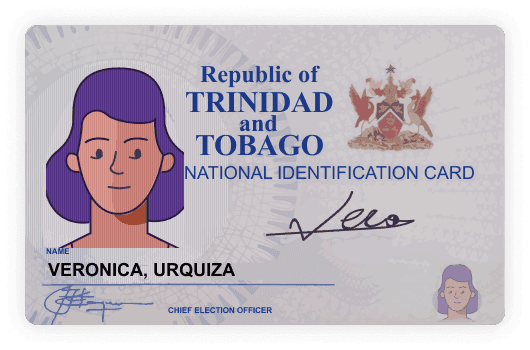
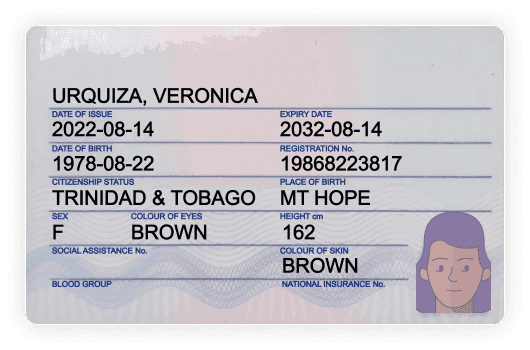
The printed text is read, through optical character recognition. Nothing else.
The printed text read by optical character recognition is validated and the captured face is compared with the photo on the document. The barcode and the MRZ are not analyzed, so there is no second element to check against, and there is no query to the issuing registry either.
Current ID card (Valid since September 2020.)
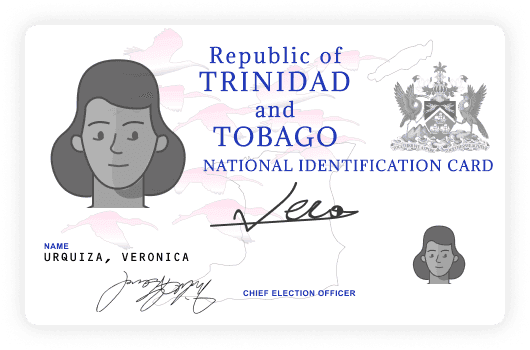
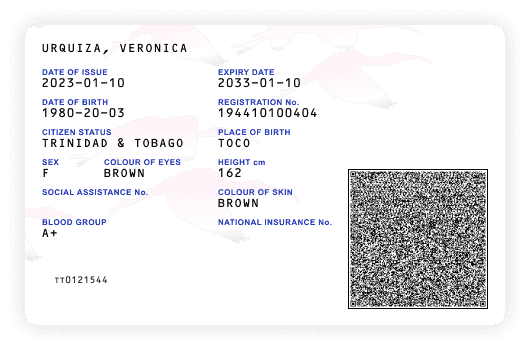
Here too, only the printed text is read. The two ID cards overlap in time: the current one starts being issued before the previous one ceases to be valid, so a sign-up flow can receive both on the same day and cannot ask the user to know which one they are holding.
The printed text read by optical character recognition is validated and the face is compared with the photo. It coexists with the old ID card, so the flow accepts both. The barcode and the MRZ are not analyzed.
Driver's permit (Valid since January 2017.)
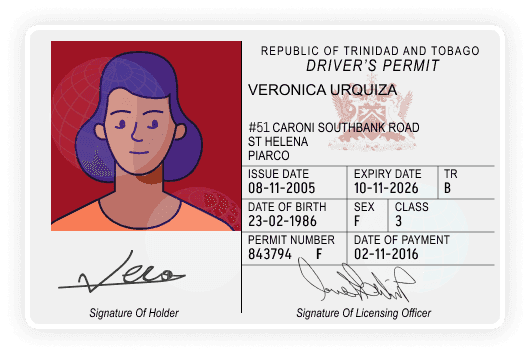
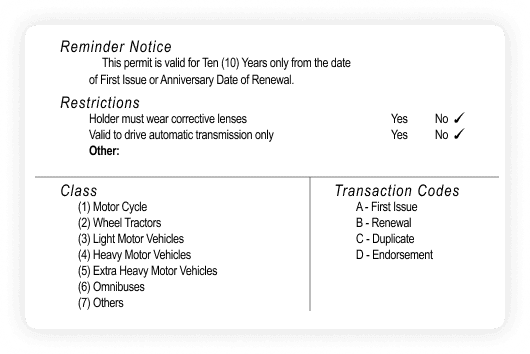
The printed text is read.
The printed text read by optical character recognition is validated and the captured face is compared with the photo on the document. The barcode and the MRZ are not analyzed, so there is no second element to check against, and there is no query to the issuing registry either.
New driver's license (Valid since July 2022.)
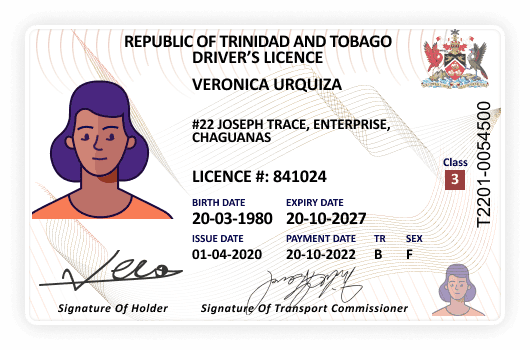
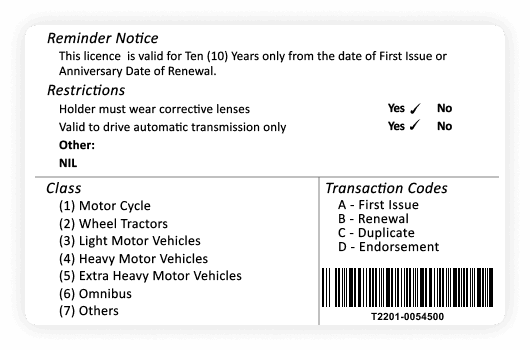
The printed text is read. As with the ID cards, the new generation does not replace the previous one overnight: both circulate.
The printed text read by optical character recognition is validated and the face is compared with the photo. It circulates alongside the previous permit, with the same standard of evidence as an ID card.
Images are reference templates with fictitious data.
- Old ID card: Until December 2021 · Printed text
- Current ID card: Since September 2020 · Printed text
- Driver's permit: Since January 2017 · Printed text
- New driver's license: Since July 2022 · Printed text
What is not read, and why
This is the most important section of the page, and it goes here and not at the end. A team that discovers this after integrating has reason to feel misled.
In Trinidad and Tobago only the printed text is read. Neither the barcode nor the machine-readable zone is analyzed, in any of the four documents. It is not a particularity of an old document or of one specific generation: it is the entire country.
Three concrete consequences, in order of impact.
- There is no internal cross-check. In other markets, the cross-check between the printed text and the machine-readable zone is the cheapest consistency check that exists: two representations of the same data within the same card, which have to match. Here that check does not exist, because there is only one reading. And that single available reading is, moreover, the one most sensitive to lighting, to wear on the document and to the quality of the user's camera.
- The two absences add up. Trinidad and Tobago does not have a government source query either, as explained below. The two levers that most strengthen a verification, the document's internal cross-check and the check against the issuer's registry, are both missing. What is left holding up the process is the quality of the text reading, biometric matching and liveness detection. Here the biometric control and exception design are not a complement to the flow: they are the flow.
- Coverage documents four documents and no more. Two ID cards and two driving documents. The local passport and the documents of foreign nationals are left out, and need an exception route defined before going to production.
A question the page leaves open on purpose: whether the barcode and the machine-readable zone physically exist on these documents and are simply not analyzed, or whether they are not on the card at all, is something this page does not answer. The two possibilities lead to different decisions, and this page does not assert either of them.
The honest flip side, which is also true. Coverage includes four types of document, among them two driving documents, which in many flows are the document people actually have at hand. It covers two document families and reads only the printed text of each. That is the trade-off there is, and stating it in full is more useful than keeping only the convenient half.
What it is checked against
Checking against the registry of the body that issued the document is different from validating what the document shows. A document is a printed claim: it states a name, a number and a date. Asking the registry whether that person exists as declared is another check, a stronger one, and it is what separates a process that reviews a card from one that confirms an identity.
Within VU's coverage, verification in Trinidad and Tobago does not query a government source. Where that query exists, the nature of the check changes: it stops merely validating what the document shows and moves on to checking against the record of the body that issued it. A team running the same flow in several markets is not buying the same control in each, and it is worth knowing that before designing the exception process.
Saying it precisely matters more than leaving the ambiguity, especially here, where it adds to the reading limitation described above.
What VU automates in identity verification
VU handles the mechanical, repeatable part of the four checks, within a single flow.
- Document reading — capture and extraction of the fields according to what each of the country's documents supports.
- Biometric matching — the captured face against the one on the document. The front-and-back cross-check of the document itself is a text one: it compares the names field read on each side.
- Liveness detection — to establish that there is a real, present person at the moment of capture.
- Orchestration of the steps — the order, retries, timeouts and what to do when a step does not complete, which is where a digital sign-up breaks down in practice and, in this market, where the most is at stake.
- Trail of each step — the record of what ran, with what result and when, which is what gets shown later.
And what VU does not do, which matters just as much:
- It does not decide whether a person is acceptable. That is the obligated party's risk policy, and the law requires it of them, not of their provider.
- It does not issue or correct documents. That belongs to the issuing bodies. If a piece of data in the registry is wrong, the verification will reflect that error, not fix it.
- It does not interpret the law or assemble the regulatory customer file. VU produces evidence; what is retained, for how long and in what format is defined by the regime and decided by the compliance team.
- It does not verify documents outside the country's coverage. A passport or a foreign document needs another route.
- It does not make up for what the document does not provide. If a document does not offer a second reading mechanism to check against, no provider can invent it. What can be done is to design the flow knowing that, and that starts with not promising a check that is not going to happen.
- It does not do transaction monitoring. Verification establishes who someone is at sign-up. What that person does afterwards is another control and another page.
Use cases in Trinidad and Tobago
Where this problem shows up in the real operation of the local market.
Remote sign-up in banking and wallets. Identification went from an employee looking at a document to a process that has to prove itself, on a channel that is also the growth channel.
Driving documents used as identification. It is the document many people have at hand, and the flow has to accept it with the same standard of evidence as an ID card, not as a special case.
Two generations of ID card coexisting. The validity periods overlap, so both reach the same form and neither can be rejected on account of age.
Poor-quality captures on the only reading mechanism available. Without a second element to check against, a badly lit photo or a worn document does not degrade the reading: it leaves it without a safety net.
Foreign population with documents outside coverage. Residents and people in transit who present something the automatic flow does not read, and who need an exception route defined in advance.
English-language documents within a flow designed for the Spanish-speaking region. The fields, date formats and naming conventions do not match those of a Spanish-language document, and a flow that takes that for granted fails at normalization before it fails at reading.
Frequently asked questions
The national identification card, in the two generations in circulation, and the two driving documents covered. It is a more varied document base than in other markets in the region, where coverage is usually limited to the identity document, and that variety has a concrete advantage: the driving document is the one many people carry with them. What a serious process has to account for is that the generations overlap in time, so the flow accepts all four documents without asking the user to know which one corresponds to which period.
Only the printed text, through optical character recognition. The barcode and the machine-readable zone are not analyzed in any of the country's documents, and that is a real difference from most markets in the region, where the cross-check between the text and the zone is the cheapest consistency check that exists within the document itself. The practical consequence is direct: capture quality and the biometric control stop being a complement and become what holds up the process. A team that integrates assuming it will be able to parse a machine-readable zone finds that this input is not available.
No. Identity verification establishes that a person is who they claim to be and produces the evidence of that check. KYC is the broader duty of the prevention regime: besides identifying, it includes understanding the customer's profile, scaling diligence by their risk, keeping the information up to date throughout the relationship and retaining the customer file. Identity verification is the first link in that duty and the one that produces the proof, but a process can verify flawlessly and still fail to comply with KYC.
Within VU's coverage, verification in Trinidad and Tobago does not query a government source. Checking against the issuer's registry is different from validating what the document shows: the first asks whether that person exists as declared, the second only checks that the card is consistent with itself. What is worth having clear is what remains on the process side when that query is not there: the reading of the document, biometric matching of the face against the photo and liveness detection at capture.
An image of the document settles only one of the four checks, and only partly. It makes it possible to read the data, but it says nothing about whether the sender is the holder, whether there is a real person on the other side at that moment, or whether the data is consistent with any source. A process built on a photo sent over a messaging app is the easiest scenario to attack there is: the image can be of a stolen document, a screenshot or a purchased file. In a market where the document provides a single reading mechanism, that weakness weighs even more.