What identity verification requires in Uruguay
The obligation does not come from a rule about documents: it comes from the fact that the Uruguayan regime for preventing money laundering and terrorist financing requires knowing the customer before they transact. Verifying identity is the first link in that duty, and the one that produces the evidence on which all the others rest.
Who supervises that compliance depends on the activity: institutions in the financial system answer to the BCU, the Banco Central del Uruguay, and the non-financial activities covered by the obligation answer to SENACLAFT, the Secretaría Nacional para la Lucha contra el Lavado de Activos y el Financiamiento del Terrorismo. The duty to identify is the same; what changes is who comes to look at it.
In Uruguay the document is the cédula de identidad (national ID card) and the body that issues it is the DNIC, the Dirección Nacional de Identificación Civil. That distinction sets the quality ceiling of any verification: the document is a printed claim, and the DNIC's registry is what that claim would be checked against.
Translated into what a process has to settle, these are four distinct checks, and all four have to leave a record.
- That the document is authentic — full reading of the document presented and validation of its security features, not just the number.
- That the person on the document is the one on the other side — biometric matching between the captured face and the one on the document.
- That this person is present and alive — liveness detection, which is what separates a real face from a photo, a recorded video or a synthetic face.
- That the declared data is consistent — cross-checking against the available sources and against the applicable restricted lists.
All four produce evidence. That evidence is the customer file, and the customer file is what the supervisor looks at.
The Uruguayan documents that are read
Uruguay has two documents covered, and both coexist in circulation at the same time. What is striking about the Uruguayan picture is not that they are few, but that each one carries an automatic reading element the other does not have.
Identity document with chip (Issued since 2015.)
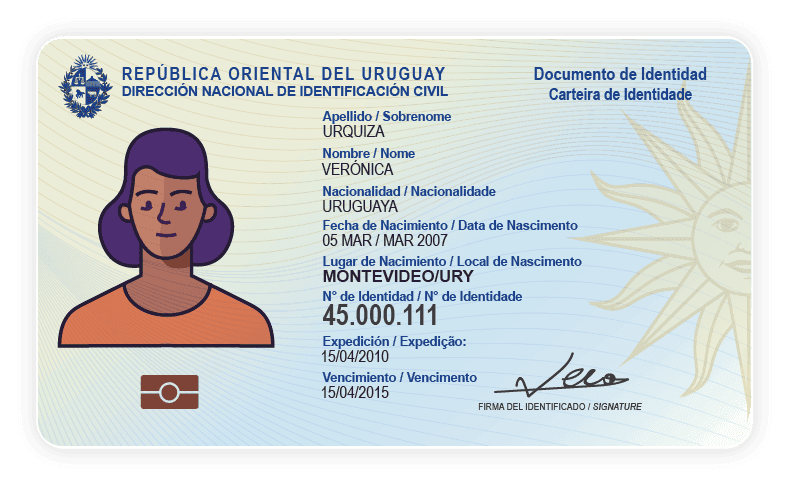
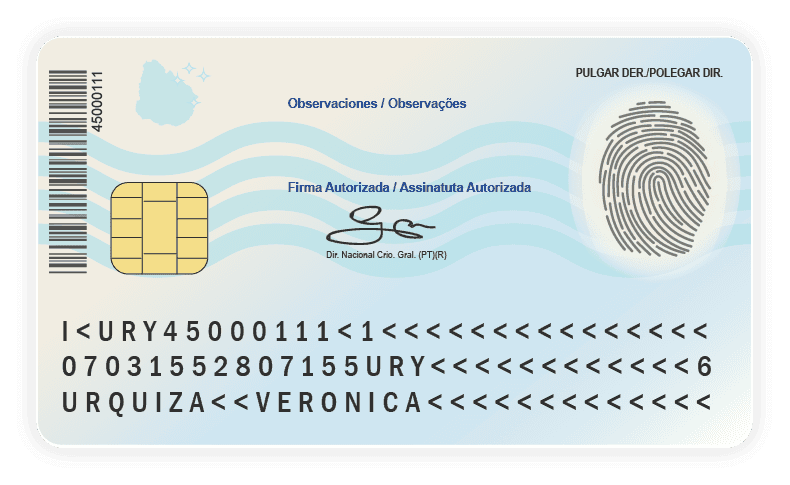
The printed text and the machine-readable zone are read. It has no barcode.
The match between the printed data and the MRZ is validated. It has no barcode and the chip is not read, and there is no online query to the DNIC, so the check relies on the document and biometrics.
Cédula de identidad (Issued until 2015.)
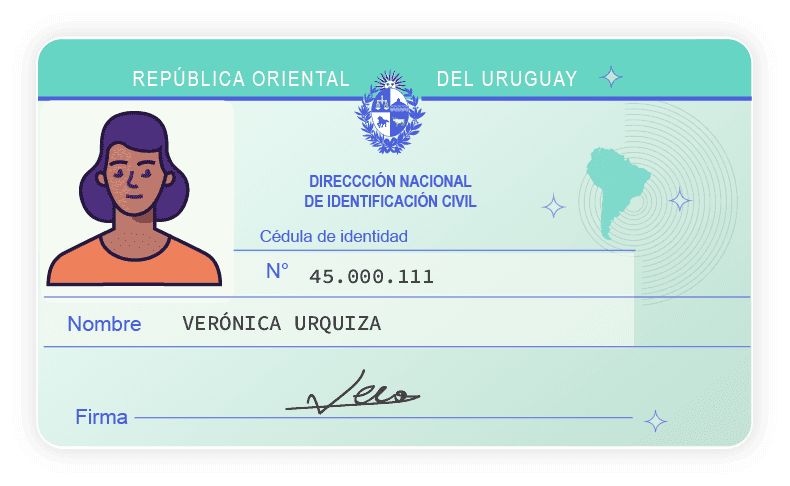
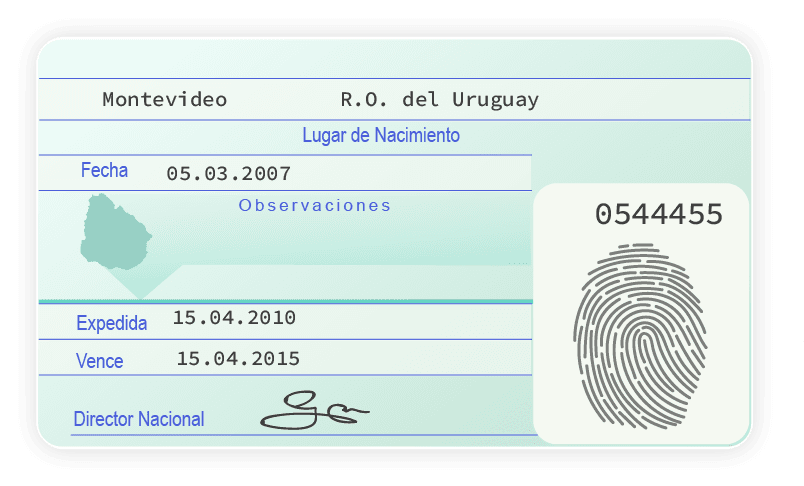
The printed text and the barcode are read. It has no machine-readable zone.
The match between the printed data and the barcode is validated. It has no MRZ and there is no online query to the DNIC, so the internal cross-check relies only on those two elements and on biometrics.
Images are reference templates with fictitious data.
- Identity document with chip: Since 2015 · Printed text · machine-readable zone
- Cédula de identidad: Until 2015 · Printed text · barcode
The practical consequence is the reverse of that in other markets. In Argentina the generations share mechanisms and the newest one changes one; in Uruguay the two generations share no mechanism beyond the printed text. A Uruguayan flow needs both reading routes from day one, and it cannot treat the previous generation as a rare case to be handled later: it is still in circulation.
What it is checked against
Within VU's coverage, verification in Uruguay does not query a government source. Identification relies on reading the document presented and on biometric matching of the person, with no online cross-check against an official Uruguayan registry.
Saying it precisely matters more than leaving the ambiguity. Where that query exists, the nature of the check changes: it stops merely validating what the document shows and moves on to checking against the record of the body that issued it. A team running the same flow in several markets is not buying the same control in all of them, and it is worth knowing that before designing the exceptions process.
In Uruguay that shifts the weight of the check to two places: the quality of the document reading and the quality of the biometric control. It is not a limitation that is solved with more steps in the form; it is one that is solved with better reading and with evidence that the presence control withstands an attack.
What is not read, and why
Three clarifications that prevent a mistaken expectation. The third is the most important.
- The chip in the new document is not read. The most recent document has a chip and the Uruguayan coverage does not read it: from that document, the printed text and the machine-readable zone are read. It is the same gap between the popular name of the document and what a process actually extracts from it that appears in the Chilean ID card.
- The new document has no barcode and the previous one has no machine-readable zone. It is not a shortcoming of the reading; it is how the documents are made. What is a design consequence is that neither of the two routes can be reused for the other.
- Uruguayan coverage is the cédula, and the cédula only. It does not include the Uruguayan passport or documents of foreign nationals. A flow that receives a passport or another country's identity card falls outside this coverage and needs an exception route defined in advance.
What VU automates in identity verification
VU handles the mechanical, repeatable part of the four checks, within a single flow.
- Document reading — capture and extraction of the fields according to what each generation supports: printed text in both, machine-readable zone in the newest, barcode in the previous one.
- Biometric matching — the captured face against the one on the document, with the front and back of the document itself cross-checked.
- Liveness detection — to establish that there is a real, present person at the moment of capture.
- Orchestration of the steps — the order, retries, timeouts and what to do when a step does not complete, which is where a remote onboarding breaks down in practice.
- Trail of each step — the record of what ran, with what result and when, which is what gets shown later.
And what VU does not do, which matters just as much:
- It does not decide whether a person is acceptable. That is the obligated party's risk policy, and the law requires it of them, not of their provider.
- It does not issue or correct documents. That belongs to the DNIC. If a piece of data in the registry is wrong, the verification will reflect that error, not fix it.
- It does not query the Uruguayan identity registry. In Uruguay the check is done on the document and the person, with no online cross-check against the source that issued it.
- It does not interpret the law or assemble the regulatory customer file. VU produces evidence; what is retained, for how long and in what format is defined by the regime and decided by the compliance team.
- It does not verify documents outside the country's coverage. A Uruguayan passport or a foreign document in a Uruguayan flow needs another route.
- It does not replace consent or the privacy notice. The legal basis for processing biometric data, the declared purpose and the notice to the data subject are obligations of the data controller under the Uruguayan personal data regime.
- It does not do transaction monitoring. Verification establishes who someone is at sign-up. What that person does afterwards is another control and another page.
Use cases in Uruguay
Where this problem shows up in the real operation of the Uruguayan market.
Remote customer onboarding in the financial system. Sign-up at a distance stopped being an alternative channel, and with it identification went from an employee looking at a cédula to a process that has to prove itself.
Two generations of document with different reading mechanisms. A flow that handles the new document well and treats the previous one as a manual exception builds up a review queue with a large part of the document base, not with a rare case.
Non-financial obligated parties. Activities covered by the obligation to know the customer that have neither the scale nor the compliance team of a bank, and that also answer to SENACLAFT and not to the BCU.
Two readings of the same capture. The same face captured at sign-up can be looked at by the anti-money laundering supervisor and by the personal data protection one, with different questions about the same file.
Transactions with a document outside coverage. Foreign nationals, resident or in transit, and holders who present a passport, whom the automatic flow does not read and who need an exception route defined before the first case appears.
Frequently asked questions
The Uruguayan cédula de identidad (national ID card), in the generations that are valid at the time of verification. In Uruguay the previous generation and the most recent document coexist, and a serious process has to cover both, not just the newest. What changes between generations is not the legal value of the document but what elements it carries to be read automatically, and in the Uruguayan case that difference is large: the two documents do not share the same reading mechanism beyond the printed text. The flow is designed on the real document base, not on the ideal one.
No. Identity verification establishes that a person is who they claim to be and produces the evidence of that check. KYC is the broader duty the prevention regime requires: besides identifying, it includes understanding the customer's profile, scaling diligence by their risk, keeping the information up to date throughout the relationship and retaining the customer file. Identity verification is the first link in that duty and the one that produces the proof, but a process can verify flawlessly and still fail to comply with KYC.
Checking against the registry of the issuing body is different from validating what the document shows: the first asks whether that person exists as declared, the second only checks that the document is consistent with itself. In the document coverage available, Uruguay does not have that online query. What is handled without it is the full reading of the document, the validation of its elements and the biometric matching of the person against the photo, with liveness detection at capture.
It depends on the generation, and in Uruguay that dependence is stronger than in other markets. The most recent document carries printed text and a machine-readable zone; the previous generation carries printed text and a barcode. In other words, the automatic element of one does not exist in the other. The practical consequence is that a Uruguayan flow keeps two reading routes in parallel from the start, and that assuming a single mechanism for all Uruguayan documents fails with a generation that is still in circulation, not with a marginal case.
An image of the document settles only one of the four checks, and only partly. It makes it possible to read the data, but it says nothing about whether the sender is the holder, whether there is a real person on the other side at that moment, or whether the data is consistent with any source. A process built on a photo sent over a messaging app is the easiest scenario to attack there is: the image can be of a stolen document, a screenshot or a purchased file. In a market with no check against an official registry, that weakness weighs even more.
Sources
- DNIC · Dirección Nacional de Identificación Civil (civil ID office)
- BCU · Banco Central del Uruguay
- BCU · Superintendencia de Servicios Financieros (financial supervisor)
- SENACLAFT · Secretaría Nacional contra el Lavado de Activos (AML secretariat)
- Law 19,574 · comprehensive anti-money laundering law (IMPO)
- Law 18,331 · Personal Data Protection (IMPO)